UPSC Current Affairs
SHAHED 136 DRONE ATTACKS
During the ongoing West Asia conflict, Iran has repeatedly used Shahed-136 drones to attack military targets linked to United States bases in the Gulf region. Reports suggest these attacks have damaged radar and communication infrastructure in several countries hosting US military facilities. The conflict highlights a new warfare pattern where low-cost drones challenge expensive air defence systems.
VRAuthor Desk
3 min read
During the ongoing West Asia conflict, Iran has repeatedly used Shahed-136 drones to attack military targets linked to United States bases in the Gulf region. Reports suggest these attacks have damaged radar and communication infrastructure in several countries hosting US military facilities. The conflict highlights a new warfare pattern where low-cost drones challenge expensive air defence systems.
Why in News?
- During the ongoing West Asia conflict, Iran has repeatedly used Shahed-136 drones to attack military targets linked to United States bases in the Gulf region.
- Reports suggest these attacks have damaged radar and communication infrastructure in several countries hosting US military facilities.
- The conflict highlights a new warfare pattern where low-cost drones challenge expensive air defence systems.
WHAT IS SHAHED 136 DRONES?
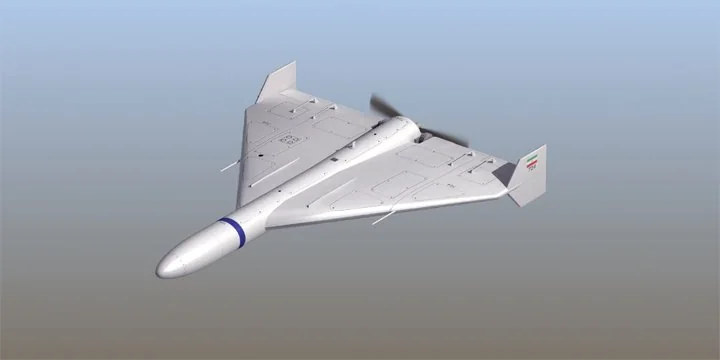
- The Shahed-136 is an Iranian loitering munition (suicide drone).
- Key characteristics:
- Designed to hover in the air before striking a target
- Operates as a one-way attack drone
- Carries an explosive payload
- Because of its low cost and simple design, it can be deployed in large numbers.
IRAN’S STRATEGY: PROJECTILE SATURATION
- Iran is using a strategy known as projectile saturation.
- This means launching large numbers of drones and missiles simultaneously to overwhelm enemy air defence systems.
- Instead of relying on precision weapons, the strategy focuses on:
- Mass deployment
- Continuous attacks
- Exhausting enemy interception systems.
COST COMPARISON
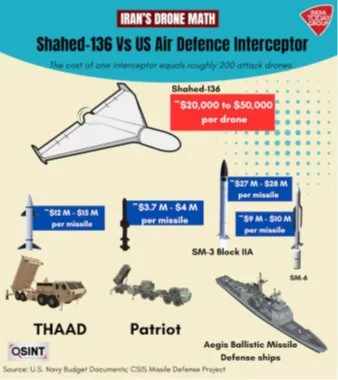
- One major reason for the effectiveness of this strategy is the huge cost difference between attack drones and interception missiles.
- Cost of Shahed-136 Drone
- USD 20,000 – USD 50,000
- About ₹18 lakh – ₹46 lakh
| Defence System |
Approx Cost per Interceptor |
| Patriot Missile System |
USD 3.7 – 4 million (₹34–37 crore) |
| THAAD Interceptor |
USD 12 – 15 million (₹110–137 crore) |
| SM-6 Missile |
USD 9 – 10 million (₹82–92 crore) |
| SM-3 Missile |
USD 27 – 28 million (₹247–256 crore) |
This means
.
IMPACT ON US AIR DEFENCE SYSTEMS
- Iran’s drone attacks are putting pressure on advanced US missile defence systems, including:
- Patriot Air Defence System
- THAAD (Terminal High Altitude Area Defence)
- Aegis Ballistic Missile Defence System
- These systems rely on high-cost interceptor missiles, which are limited in number.
- If attacks continue at the same pace, there is concern that interceptor stocks could be exhausted faster than Iran runs out of drones.
TARGETED INFRASTRUCTURE
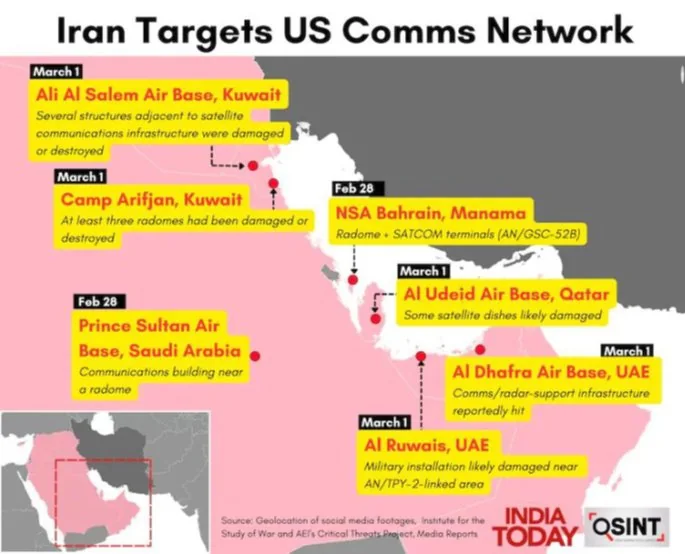
- Reports suggest Iranian strikes targeted communication and radar infrastructure at US-linked military bases in several Gulf countries.
- Possible affected locations include:
- Ali Al Salem Air Base – Kuwait
- Camp Arifjan – Kuwait
- Manama facilities – Bahrain
- Prince Sultan Air Base – Saudi Arabia
- Al Udeid Air Base – Qatar
- Al Dhafra Air Base – United Arab Emirates
- Al Ruwais military installation – UAE
Damage reportedly included:
- Radar domes (Radomes)
- Satellite communication terminals
- Communication buildings
These facilities are part of the
regional air defence coordination network.
IMPORTANCE OF RADAR COMMUNICATION SYSTEMS
- These installations form the communication backbone of US military operations in the Gulf.
- They support:
- Missile detection systems
- Satellite communication
- Air defence coordination
- Early warning networks
- Damage to these systems can disrupt regional defence coordination.
ABOUT THE THAAD MISSILE DEFENCE SYSTEM
- The Terminal High Altitude Area Defence (THAAD) system is one of the most advanced missile defence platforms developed by the United States.
- Main Purpose
- Designed to intercept short, medium and intermediate-range ballistic missiles during the final stage of flight.
KEY FEATURES OF THAAD
- Uses “Hit-to-Kill” technology (destroys targets through direct collision)
- Can intercept missiles inside and outside the Earth’s atmosphere
- Engagement range: 150–200 km
- Part of the broader Ballistic Missile Defence System (BMDS).
COMPONENTS OF A THAAD BATTERY
A typical
THAAD battery includes:
- Interceptor missiles
- Truck-mounted launchers
- AN/TPY-2 radar system
- Fire control and communication unit
- Logistics and support equipment
Personnel strength: around
90 personnel.
A battery usually contains:
- 6 launchers
- 48 interceptors
- Each launcher carries 8 missiles.
CONCLUSION
The increasing use of
Shahed-136 drones by Iran shows a shift in modern warfare toward
low-cost, mass-produced weapons that can challenge expensive defence systems. By launching large numbers of drones, Iran is attempting to
overwhelm and economically strain advanced US air defence systems, highlighting a growing
asymmetry between inexpensive attack technologies and costly missile interception systems.
- Prelims: Key facts, institutions, locations and terminology in the article.
- Mains: Connect the topic with Economy, International Relations, Defence.
- Revision: Use the article headings to prepare concise notes and answer-writing points.
Test your understanding
Questions from this article
Prelims practiceWith reference to SHAHED 136 DRONE ATTACKS, consider the following statements:
- During the ongoing West Asia conflict, Iran has repeatedly used Shahed-136 drones to attack military targets linked to United States bases in the Gulf region.
- Reports suggest these attacks have damaged radar and communication infrastructure in several countries hosting US military facilities.
- The conflict highlights a new warfare pattern where low-cost drones challenge expensive air defence systems.
Which of the statements given above are correct?
- 1 and 2 only
- 2 and 3 only
- 1 and 3 only
- 1, 2 and 3
View answer
Answer: (d) 1, 2 and 3. All three statements are drawn from the article.
Mains practiceDiscuss the background, key issues and significance of SHAHED 136 DRONE ATTACKS for India.
Answer in 250 words.
View answer approach
- Why in News?
- WHAT IS SHAHED 136 DRONES?
- IRAN’S STRATEGY: PROJECTILE SATURATION
- COST COMPARISON
- IMPACT ON US AIR DEFENCE SYSTEMS
Frequently asked questionsFrequently asked questions
Why is Shahed 136 Drone Attacks in the news?
During the ongoing West Asia conflict, Iran has repeatedly used Shahed-136 drones to attack military targets linked to United States bases in the Gulf region. Reports suggest these attacks have damaged radar and communication infrastructure in several countries hosting US military facilities.
What are the key facts about Shahed 136 Drone Attacks?
The conflict highlights a new warfare pattern where low-cost drones challenge expensive air defence systems. The Shahed-136 is an Iranian loitering munition (suicide drone). Key characteristics: Designed to hover in the air before striking a target Operates as a one-way attack drone Carries an explosive payload Because of its low cost and simple design, it can be deployed in large numbers.
Why is Shahed 136 Drone Attacks important for UPSC preparation?
The topic connects current developments with Economy, International Relations, Defence and is relevant for both objective revision and analytical answer writing.