UPSC Current Affairs
QDENGA: INDIA’S FIRST DENGUE VACCINE
Context The Drug Controller General of India (DCGI) has granted market authorisation to Takeda Biopharmaceuticals India’s QDENGA (TAK-003), making it the first dengue vaccine approved in India. The vaccine has been approved for the prevention of dengue disease in individuals aged 4 to 60 years. The approval marks a significant milestone in India's efforts to reduce the burden of dengue, which remains one of the country's major vector-borne diseases.
VRAuthor Desk
4 min read
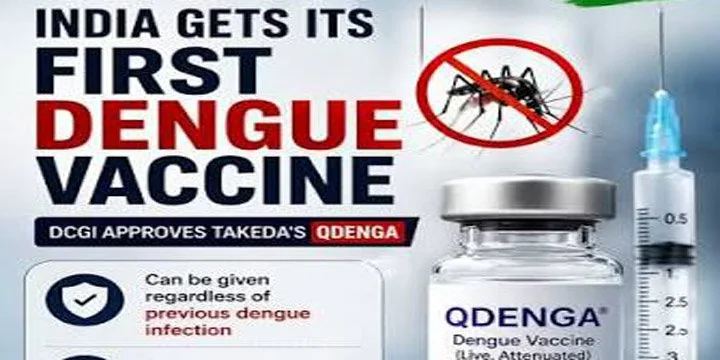
Context The Drug Controller General of India (DCGI) has granted market authorisation to Takeda Biopharmaceuticals India’s QDENGA (TAK-003), making it the first dengue vaccine approved in India. The vaccine has been approved for the prevention of dengue disease in individuals aged 4 to 60 years. The approval marks a significant milestone in India's efforts to reduce the burden of dengue, which remains one of the country's major vector-borne diseases.
Context
- The Drug Controller General of India (DCGI) has granted market authorisation to Takeda Biopharmaceuticals India’s QDENGA (TAK-003), making it the first dengue vaccine approved in India.
- The vaccine has been approved for the prevention of dengue disease in individuals aged 4 to 60 years.
- The approval marks a significant milestone in India's efforts to reduce the burden of dengue, which remains one of the country's major vector-borne diseases.
ABOUT QDENGA (TAK-003)
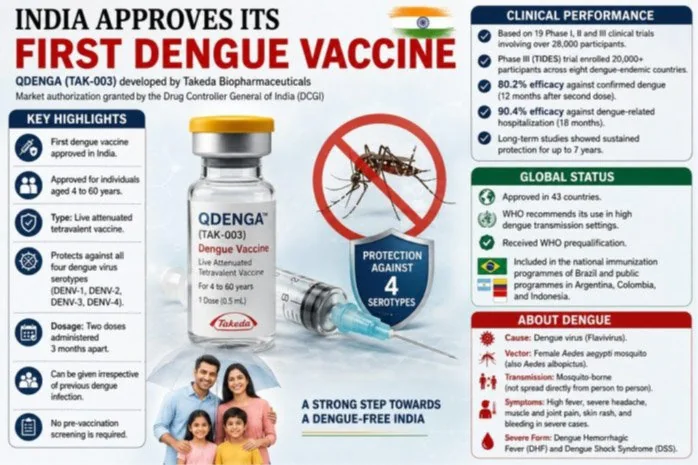
- QDENGA (TAK-003) is a live-attenuated tetravalent dengue vaccine developed by Takeda Biopharmaceuticals.
- It is designed to provide protection against all four serotypes of the dengue virus (DENV-1, DENV-2, DENV-3, and DENV-4).
- The vaccine is administered as a two-dose regimen, with the second dose given three months after the first dose.
- It can be administered irrespective of whether an individual has previously been infected with dengue.
- Unlike some earlier dengue vaccines, QDENGA does not require pre-vaccination screening for prior dengue infection.
APPROVAL BY DGCI
- The Drug Controller General of India (DCGI) is the national regulatory authority responsible for approving new drugs, vaccines, and medical devices in India.
- The approval was granted after evaluation of extensive global and Indian clinical trial data demonstrating the vaccine's safety, efficacy, and immunogenicity.
- The vaccine is approved for use in individuals aged 4–60 years.
CLINICAL TRIAL EVIDENCE
The approval is based on
Takeda's global clinical development programme, which included:
- 19 Phase I, Phase II, and Phase III clinical trials.
- More than 28,000 participants across dengue-endemic and non-endemic countries.
TIDES (DEN-301) Phase III Trial
- Included over 20,000 participants from eight dengue-endemic countries.
- Demonstrated:
- 80.2% efficacy against virologically confirmed dengue 12 months after the second dose.
- 90.4% efficacy against dengue-related hospitalization 18 months after vaccination.
- 84.1% efficacy against hospitalization after 4.5 years.
- Sustained protection against dengue disease and hospitalization over seven years across all four dengue virus serotypes.
GLOBAL STATUS
- QDENGA has been approved in 43 countries across:
- Asia.
- Latin America.
- Europe.
- More than 32 million doses have been distributed through public and private immunization programmes.
- The vaccine has received WHO prequalification.
- It is recommended by the World Health Organization (WHO) for use in dengue-endemic regions with high transmission.
- It has been incorporated into:
- Brazil's National Immunization Programme.
- Public vaccination programmes in Argentina, Colombia, and Indonesia.
ABOUT DENGUE
- Dengue is a viral disease caused by the dengue virus (DENV), which belongs to the Flavivirus
- It is transmitted primarily through the bite of infected Aedes aegypti mosquitoes, and to a lesser extent Aedes albopictus.
- There are four distinct serotypes of the dengue virus:
- DENV-1
- DENV-2
- DENV-3
- DENV-4
- Infection with one serotype provides lifelong immunity against that serotype but only temporary protection against the others.
SYMPTOMS
- High fever.
- Severe headache.
- Muscle and joint pain.
- Skin rash.
- Nausea and vomiting.
- In severe cases, dengue may progress to Dengue Hemorrhagic Fever (DHF) or Dengue Shock Syndrome (DSS), which can be life-threatening.
DENGUE BURDEN IN INDIA
- India accounts for nearly one-third of the global dengue burden.
- Reported dengue cases have increased almost eleven-fold over the past two decades.
- The actual number of infections is believed to be significantly higher than officially reported due to underreporting and asymptomatic infections.
- Dengue outbreaks occur mainly during and after the monsoon season because of increased mosquito breeding.
SIGNIFICANCE
- The approval of India's first dengue vaccine represents a major advancement in the country's public health preparedness.
- Vaccination can significantly reduce severe dengue cases and dengue-related hospitalizations.
- The vaccine strengthens India's strategy for controlling vector-borne diseases.
- It complements existing dengue prevention measures such as vector control, surveillance, and public awareness.
- The availability of a vaccine is expected to reduce healthcare costs associated with recurrent outbreaks.
- It contributes to improved health security in one of the world's largest dengue-endemic countries.
CHALLENGES
- Ensuring affordable and equitable access to the vaccine across all regions remains essential.
- Integrating the vaccine into India's immunization strategy will require careful planning.
- Continued mosquito control measures remain necessary because vaccination alone cannot eliminate dengue transmission.
- Public awareness regarding vaccine eligibility and continued preventive practices needs to be strengthened.
- Continuous surveillance will be required to monitor vaccine effectiveness under real-world conditions.
WAY FORWARD
- The Government should develop clear guidelines for the phased introduction of the dengue vaccine.
- Vaccination should complement integrated vector management and public health surveillance.
- Strengthening urban sanitation and mosquito breeding control remains critical.
- Research on long-term vaccine effectiveness and disease surveillance should continue.
- Public awareness campaigns should promote vaccination alongside preventive measures such as eliminating stagnant water and using personal protective measures.
- Prelims: Key facts, institutions, locations and terminology in the article.
- Mains: Connect the topic with Polity & Governance, Health.
- Revision: Use the article headings to prepare concise notes and answer-writing points.
Test your understanding
Questions from this article
Prelims practiceWith reference to QDENGA: INDIA’S FIRST DENGUE VACCINE, consider the following statements:
- The Drug Controller General of India (DCGI) has granted market authorisation to Takeda Biopharmaceuticals India’s QDENGA (TAK-003), making it the first dengue vaccine approved in India.
- The vaccine has been approved for the prevention of dengue disease in individuals aged 4 to 60 years.
- The approval marks a significant milestone in India's efforts to reduce the burden of dengue, which remains one of the country's major vector-borne diseases.
Which of the statements given above are correct?
- 1 and 2 only
- 2 and 3 only
- 1 and 3 only
- 1, 2 and 3
View answer
Answer: (d) 1, 2 and 3. All three statements are drawn from the article.
Mains practiceDiscuss the background, key issues and significance of QDENGA: INDIA’S FIRST DENGUE VACCINE for India.
Answer in 250 words.
View answer approach
- ABOUT QDENGA (TAK-003)
- APPROVAL BY DGCI
- GLOBAL STATUS
- ABOUT DENGUE
- SYMPTOMS
Frequently asked questionsFrequently asked questions
Why is Qdenga: India’S First Dengue Vaccine in the news?
Context The Drug Controller General of India (DCGI) has granted market authorisation to Takeda Biopharmaceuticals India’s QDENGA (TAK-003), making it the first dengue vaccine approved in India. The vaccine has been approved for the prevention of dengue disease in individuals aged 4 to 60 years.
What are the key facts about Qdenga: India’S First Dengue Vaccine?
The approval marks a significant milestone in India's efforts to reduce the burden of dengue, which remains one of the country's major vector-borne diseases. ABOUT QDENGA (TAK-003) QDENGA (TAK-003) is a live-attenuated tetravalent dengue vaccine developed by Takeda Biopharmaceuticals. It is designed to provide protection against all four serotypes of the dengue virus (DENV-1, DENV-2, DENV-3, and DENV-4).
Why is Qdenga: India’S First Dengue Vaccine important for UPSC preparation?
The topic connects current developments with Polity & Governance, Health and is relevant for both objective revision and analytical answer writing.