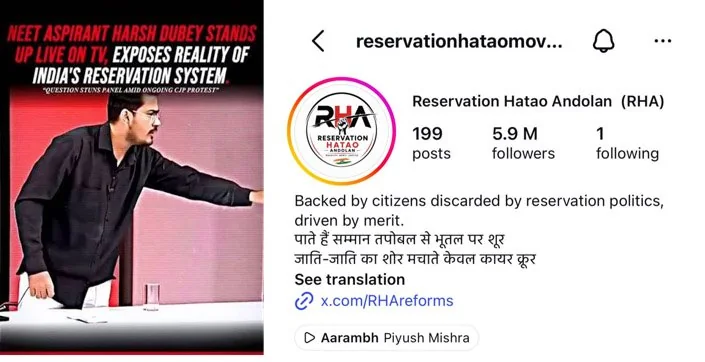
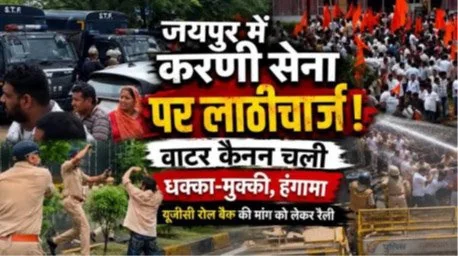
- JAIPUR: Students took to the streets and clashed with police over the now-stayed UGC's caste equity regulations.
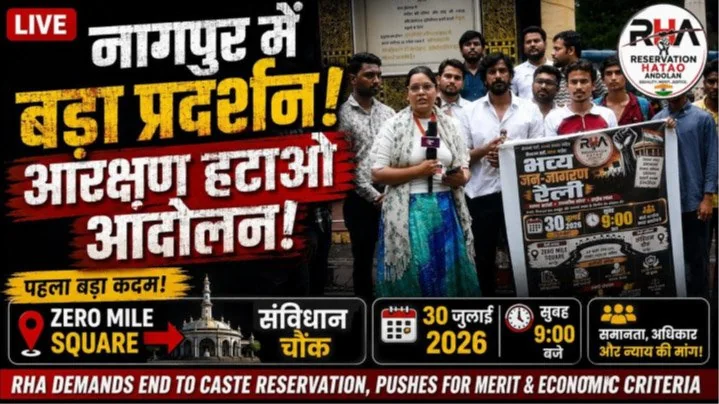
- NAGPUR: The Reservation Hatao Movement (RHM) on July 30 made its on-ground debut in Nagpur with a rally.
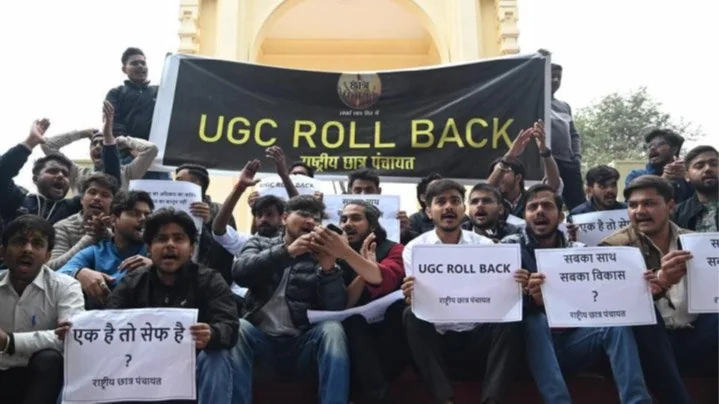
- LUCKNOW: They demanded a complete rollback of UGC rules and an end to caste-based reservation.
- VISAKHAPATNAM: Students preparing for the National Eligibility-cum-Entrance Test (NEET) staged a silent protest in support of the Reservation Hatao Andolan (RHA) GEN-Z campaign.
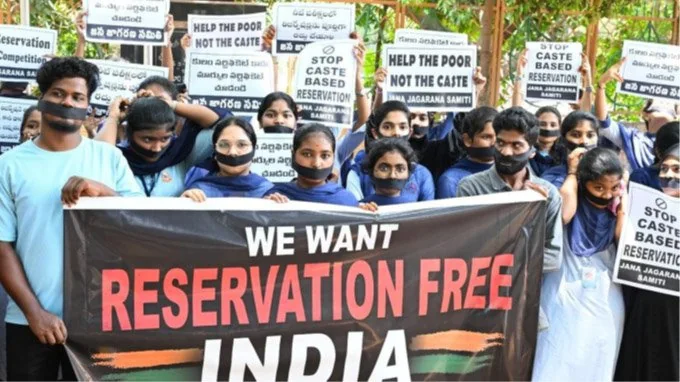
CORE DEMANDS OF RESERVATION HATAO ANDOLAN
- The movement seeks to replace caste-based quotas with "income-based reservations."
- It argued that "poverty has no caste".
- "One family, One reservation, One time"
- A minimum qualifying mark for all categories, and
- The transfer of unfilled reserved seats to the general category.
- Periodic reviews to move economically advanced communities off of the reservation list.
The proposal further called for a
"sunset clause" to gradually phase out reservations as educational inequality narrows, while banning political parties from promising new or higher reservation quotas during elections.
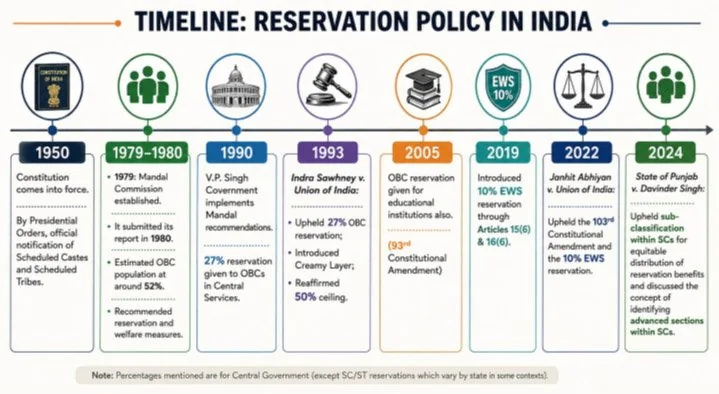
EVOLUTION OF RESERVATION IN INDIA
1950: Constitution comes into force. By Presidential Orders, official notification of
Scheduled Castes and Scheduled Tribes.
1979: Mandal Commission established. It
submitted its report in 1980. Estimated OBC population at around 52%; recommended reservation and welfare measures.
1990: V.P. Singh Government
implements Mandal recommendations.
27% reservation given to
OBCs in Central Services.
1993: Indra Sawhney v. Union of India: Upheld 27% OBC reservation; introduced Creamy Layer; reaffirmed 50% ceiling.
2005: OBC reservation given for educational institutions also.
(93rd AA)
2019: Introduced
10% EWS reservation through
Articles 15(6) & 16(6)
2022: Janhit Abhiyan v. Union of India: Upheld the 103rd Constitutional Amendment and the 10% EWS reservation.
2024: State of Punjab v. Davinder Singh: Upheld
sub-classification within SCs for equitable distribution of reservation benefits and discussed the concept of identifying advanced sections within SCs.
IMPACT OF RESERVATION
POSITIVE IMPACTS
1. Promotes Social Justice
- Corrects historical discrimination and exclusion faced by SCs, STs, and socially and educationally backward classes.
- Gives practical effect to Articles 14, 15, 16, 17, and 46.
Example: Greater representation of marginalized communities in public institutions.
2. Improves Representation
- Ensures participation of disadvantaged groups in:
- Government services
- Legislatures
- Educational institutions
- Makes public institutions more representative of society.
3. Expands Educational Opportunities
- Enables first-generation learners to access higher education.
- Improves literacy and educational attainment among historically disadvantaged communities.
4. Enhances Economic Mobility
- Government employment and higher education improve income, job security, and living standards.
- Helps break intergenerational poverty.
5. Strengthens Democracy
- Broader representation increases the legitimacy and inclusiveness of democratic institutions.
- Encourages political participation among marginalized groups.
6. Reduces Social Exclusion
- Promotes integration of marginalized communities into mainstream institutions.
- Encourages greater social interaction and inclusion.
7. Encourages Inclusive Development
- Supports the constitutional vision of an egalitarian society.
- Contributes to achieving Sustainable Development Goals (SDGs), particularly those related to reducing inequalities.
8. Corrects Structural Inequalities
- Recognizes that equality requires addressing unequal starting points.
- Reflects the concept of substantive equality, not merely formal equality.
NEGATIVE IMPACTS:
1. Perceived Impact on Merit
- Critics argue that reservations may reduce the weight given to open competition in admissions and recruitment.
- Supporters counter that merit is shaped by unequal access to opportunities and resources.
2. Vote-bank Politics
- Reservation has often become a political issue.
- Demands for inclusion in reserved categories sometimes intensify around elections.
Examples: Agitations by Marathas, Jats, Patidars, Gujjars.
3. Creamy Layer Issue
- Relatively better-off members within OBCs may repeatedly benefit.
- The intended beneficiaries may not always receive the advantages.
4. Uneven Distribution of Benefits
- Within reserved categories, some communities are better represented than others.
- This concern led to discussions on sub-classification within SCs in recent judicial decisions.
5. Social Polarization
- Reservation debates can reinforce caste identities and create tensions between communities.
6. Continued Dependence on Caste
- Although intended to reduce inequality, reservation policies rely on caste as a basis for identifying beneficiaries.
- Some argue this may slow the transition toward a caste-neutral society.
7. Limited Reach
- Reservation mainly benefits those who can access schools, colleges, and competitive examinations.
- The poorest among marginalized groups may still lack the foundational education needed to benefit.
8. Does Not Address Root Causes
Reservation alone cannot overcome:
- Poor school education
- Malnutrition
- Healthcare deficits
- Lack of infrastructure
- Rural deprivation
9. Litigation and Administrative Complexity
- Frequent legal challenges create uncertainty.
- Issues such as:
- 50% ceiling
- Creamy Layer
- Reservation in promotions
- EWS criteria
- State-specific policies often require judicial clarification.
SC’s VIEWPOINT
The Supreme Court has consistently held that:
- Reservation is an instrument of substantive equality, not an exception to equality.
- At the same time, it should be implemented in a manner that preserves administrative efficiency, fairness, and the constitutional balance between equality of opportunity and affirmative action.
WAY FORWARD
- Ensure periodic review of reservation policies using updated socio-economic data.
- Improve the identification of genuinely disadvantaged beneficiaries.
- Strengthen school education and healthcare to reduce structural inequalities.
- Expand scholarships, hostels, skill development, and mentoring alongside reservations.
- Ensure transparency in implementation and effective grievance redressal.
- Promote evidence-based policy making through regular socio-economic surveys.
- Balance social justice, efficiency, and equality of opportunity in line with constitutional principles.


Test your understanding
Questions from this article
Prelims practiceWith reference to PROTESTS AGAINST RESERVATION, consider the following statements:
- JAIPUR: Students took to the streets and clashed with police over the now-stayed UGC's caste equity regulations.
- NAGPUR: The Reservation Hatao Movement (RHM) on July 30 made its on-ground debut in Nagpur with a rally.
- LUCKNOW: They demanded a complete rollback of UGC rules and an end to caste-based reservation.
Which of the statements given above are correct?
- 1 and 2 only
- 2 and 3 only
- 1 and 3 only
- 1, 2 and 3
View answer
Answer: (d) 1, 2 and 3. All three statements are drawn from the article.
Mains practiceDiscuss the background, key issues and significance of PROTESTS AGAINST RESERVATION for India.
Answer in 250 words.
View answer approach
- CORE DEMANDS OF RESERVATION HATAO ANDOLAN
- EVOLUTION OF RESERVATION IN INDIA
- IMPACT OF RESERVATION
- POSITIVE IMPACTS
- NEGATIVE IMPACTS:
Frequently asked questionsFrequently asked questions
Why is Protests Against Reservation in the news?
JAIPUR: Students took to the streets and clashed with police over the now-stayed UGC's caste equity regulations. NAGPUR: The Reservation Hatao Movement (RHM) on July 30 made its on-ground debut in Nagpur with a rally.
What are the key facts about Protests Against Reservation?
LUCKNOW: They demanded a complete rollback of UGC rules and an end to caste-based reservation. VISAKHAPATNAM: Students preparing for the National Eligibility-cum-Entrance Test (NEET) staged a silent protest in support of the Reservation Hatao Andolan (RHA) GEN-Z campaign. CORE DEMANDS OF RESERVATION HATAO ANDOLAN The movement seeks to replace caste-based quotas with "income-based reservations." It argued that "poverty has no caste".
Why is Protests Against Reservation important for UPSC preparation?
The topic connects current developments with Economy, Polity & Governance, Health and is relevant for both objective revision and analytical answer writing.