UPSC Current Affairs
PRAXIS (PLANETARY RINGS AUTONOMOUS EXPLORATION WITH IN-SITU SAMPLING)
NASA has selected PRAXIS under the Innovative Advanced Concepts (NIAC) 2026 Phase-I funding programme. The mission aims to directly sample particles from planetary ring systems, something that has never been attempted before. ABOUT PRAXIS PRAXIS stands for Planetary Rings Autonomous Exploration with In-situ Sampling.
VRAuthor Desk
2 min read
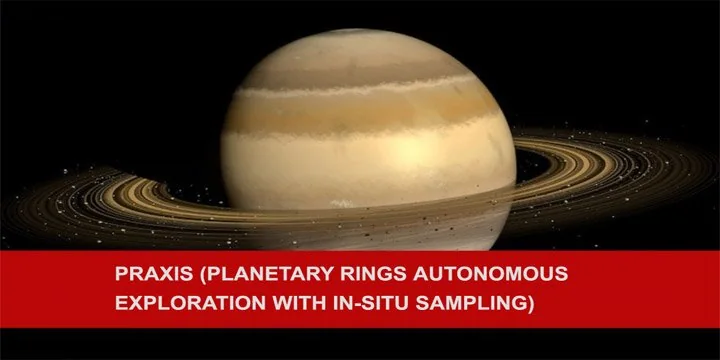
NASA has selected PRAXIS under the Innovative Advanced Concepts (NIAC) 2026 Phase-I funding programme. The mission aims to directly sample particles from planetary ring systems, something that has never been attempted before. ABOUT PRAXIS PRAXIS stands for Planetary Rings Autonomous Exploration with In-situ Sampling.
Why in News?
- NASA has selected PRAXIS under the Innovative Advanced Concepts (NIAC) 2026 Phase-I funding programme.
- The mission aims to directly sample particles from planetary ring systems, something that has never been attempted before.
ABOUT PRAXIS
- PRAXIS stands for Planetary Rings Autonomous Exploration with In-situ Sampling.
- It is a mission concept selected under NASA's Innovative Advanced Concepts (NIAC) 2026 Phase-I
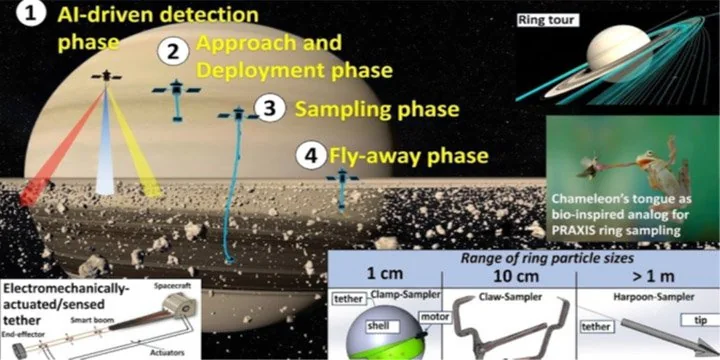
- The mission will consist of a bio-inspired robotic explorer driven by an Artificial Intelligence (AI)
- It is designed to directly sample particles from planetary ring systems.
OBJECTIVES
- Directly sample particles from planetary rings.
- Address key scientific questions related to:
- Formation of planetary rings.
- Evolution of planetary rings.
- Composition of ring particles.
KEY FEATURES
Bio-inspired AI-based Explorer
- Uses a bio-inspired robotic explorer.
- Operates using an Artificial Intelligence (AI)
Touch-and-Go Sampling
- The spacecraft will graze the ring plane instead of flying through the rings to avoid collision hazards.
- After identifying a target particle, it will perform a touch-and-go sampling operation.
- A long deployable boom will collect samples from the particle's surface while maintaining a safe distance from moving ring particles.
Multiple Sampling Locations
- After collecting one sample, the spacecraft will move to:
- Another region of the rings.
- A gap within the rings.
- This will allow sampling from different parts of the ring system.
In-situ Analysis
- Small onboard instruments will capture free-floating particles.
- The AI model will help measure:
- Particle size.
- Porosity.
- Composition.
MISSION DEVELOPMENT
- Selection under NIAC Phase-I enables the team to:
- Conduct simulations.
- Study the mission's system design.
- If selected for Phase-II, the team can:
- Develop a physical prototype.
Potential Applications
- According to its developers, the PRAXIS sampling system can be used in future missions to study multiple ringed planets.
SIGNIFICANCE
- It will be the first mission concept designed to directly sample particles from planetary ring systems.
- It seeks to answer important scientific questions identified by NASA's Planetary Science Decadal Survey regarding the formation, evolution and composition of planetary rings.
- The mission demonstrates the use of AI-driven autonomous exploration and in-situ sampling for future planetary missions.
- Prelims: Key facts, institutions, locations and terminology in the article.
- Mains: Connect the topic with Economy.
- Revision: Use the article headings to prepare concise notes and answer-writing points.
Test your understanding
Questions from this article
Prelims practiceWith reference to PRAXIS (PLANETARY RINGS AUTONOMOUS EXPLORATION WITH IN-SITU SAMPLING), consider the following statements:
- NASA has selected PRAXIS under the Innovative Advanced Concepts (NIAC) 2026 Phase-I funding programme.
- The mission aims to directly sample particles from planetary ring systems, something that has never been attempted before.
- PRAXIS stands for Planetary Rings Autonomous Exploration with In-situ Sampling.
Which of the statements given above are correct?
- 1 and 2 only
- 2 and 3 only
- 1 and 3 only
- 1, 2 and 3
View answer
Answer: (d) 1, 2 and 3. All three statements are drawn from the article.
Mains practiceDiscuss the background, key issues and significance of PRAXIS (PLANETARY RINGS AUTONOMOUS EXPLORATION WITH IN-SITU SAMPLING) for India.
Answer in 250 words.
View answer approach
- Why in News?
- ABOUT PRAXIS
- OBJECTIVES
- KEY FEATURES
- MISSION DEVELOPMENT
Frequently asked questionsFrequently asked questions
Why is Praxis (Planetary Rings Autonomous Exploration With In-Situ Sampling) in the news?
NASA has selected PRAXIS under the Innovative Advanced Concepts (NIAC) 2026 Phase-I funding programme. The mission aims to directly sample particles from planetary ring systems, something that has never been attempted before.
What are the key facts about Praxis (Planetary Rings Autonomous Exploration With In-Situ Sampling)?
ABOUT PRAXIS PRAXIS stands for Planetary Rings Autonomous Exploration with In-situ Sampling. It is a mission concept selected under NASA's Innovative Advanced Concepts (NIAC) 2026 Phase-I The mission will consist of a bio-inspired robotic explorer driven by an Artificial Intelligence (AI) It is designed to directly sample particles from planetary ring… OBJECTIVES Directly sample particles from planetary rings.
Why is Praxis (Planetary Rings Autonomous Exploration With In-Situ Sampling) important for UPSC preparation?
The topic connects current developments with Economy and is relevant for both objective revision and analytical answer writing.