Background
- Prime Minister Narendra Modi started a five-nation foreign tour on 15 May 2026.
- Countries Included:
- United Arab Emirates (UAE)
- Netherlands
- Norway
- Sweden
- Italy
- The visit is happening during the ongoing Iran-West Asia conflict, which has created:
- Rising oil prices
- Supply chain disruptions
- Global energy uncertainty
- Prime Minister Narendra Modi visited the United Arab Emirates (UAE) on 15 May 2026 as the first stop of his five-nation diplomatic tour
- During the visit, PM Modi held extensive discussions with UAE President Mohamed bin Zayed Al Nahyan in Abu Dhabi.
SIGNIFICANCE OF THE VISIT
- A landmark Strategic Defence Partnership Framework,
- Major energy security agreements,
- A $5 billion UAE investment package for India,
- Cooperation in Artificial Intelligence (AI) and supercomputing,
- Maritime infrastructure agreements,
- And enhanced trade and connectivity initiatives.
The visit took place during a period of:
- Rising tensions in West Asia,
- The ongoing Iran conflict,
- Growing uncertainty in global energy markets,
- Supply-chain disruptions,
- And concerns over safe shipping routes in the Gulf region.
Because India imports a large portion of its energy requirements from West Asia, the visit had major strategic and economic importance.
HISTORICAL BACKGROUND OF INDIA UAE TIES
Ancient Trade and Cultural Links
India and the Gulf region have shared historical ties for centuries through:
- Maritime trade,
- Cultural exchanges,
- Commercial partnerships across the Arabian Sea.
HISTORICAL TRADE TIES
Historically, traders exchanged:
- Spices,
- Pearls,
- Dates,
- Cotton textiles,
- Fishery products,
- Precious goods.
Western Indian coastal states such as:
- Gujarat,
- Kerala, maintained close trading relations with Gulf ports.
These historical interactions helped create:
- Strong commercial trust,
- Cultural familiarity,
- Deep people-to-people connections.
ESTABLISHMENT OF DIPLOMATIC RELATIONS
- Formal diplomatic relations between India and UAE were established in: 1972
After this:
- Embassies were opened,
- Trade expanded,
- Labour migration increased,
- Strategic cooperation gradually strengthened.
Transformation After 2015
- India–UAE relations entered a new phase after PM Modi’s historic UAE visit in: 2015
This visit was historic because:
- It was the first visit by an Indian Prime Minister in 34 years,
- It marked the beginning of a broader Comprehensive Strategic Partnership.
Since then:
- PM Modi has visited UAE 7 times since 2014.
- UAE President Sheikh Mohamed bin Zayed has visited India five times.
This high-level engagement reflects:
- Strong political trust,
- Shared strategic interests,
- Long-term economic cooperation.
IMPORTANCE OF UAE FOR INDIA
The UAE is one of India’s most important partners in:
- Energy,
- Trade,
- Investment,
- Maritime connectivity,
- Defence,
- Technology,
- Diaspora relations.
IMPORTANCE IN ENERGY SECURITY
India imports a large percentage of its:
- Crude oil,
- Natural gas,
- LPG requirements from abroad.
The UAE is among India’s most trusted energy suppliers.
In FY 2024–25, UAE was:
- India’s 4th largest crude oil supplier,
- 3rd largest LNG supplier,
- Largest LPG supplier,
- 2nd largest export destination for Indian petroleum products.
This makes UAE extremely important for:
- India’s transportation sector,
- Industrial production,
- Economic stability,
- Energy security framework.
IMPORTANCE IN TRADE & INVESTMENT
- India–UAE economic relations have expanded rapidly.
Bilateral merchandise trade crossed:
- $101.25 billion in FY 2025–26. This is the 1st time trade crossed the $100 billion mark.
- Both countries have now set a target to: Increase trade to $200 billion by 2032.
IMPORTANCE OF INDIAN DIASPORA
Indians are the largest expatriate community in the UAE.
Millions of Indians work in:
- Construction,
- Healthcare,
- IT,
- Retail,
- Banking,
- Hospitality,
- Logistics,
- Engineering sectors.
These workers contribute to:
- UAE’s economic growth,
- India’s remittance inflows,
- India’s foreign exchange reserves.
The Indian diaspora acts as a major:
- Cultural bridge,
- Economic bridge, between the two countries.
INDIA’S POSITION DURING THE VISIT
PM Modi:
- Strongly condemned recent attacks on the UAE,
- Expressed solidarity with UAE leadership,
- Supported safe and uninterrupted navigation through the Strait of Hormuz.
India stated that secure maritime routes are essential for:
- Regional peace,
- Global trade,
- Energy security,
- Food security.
MAJOR OUTCOMES OF THE VISIT
Outcome 1: Strategic Collaboration on Petroleum Reserves
Agreement Between:
- Indian Strategic Petroleum Reserves Limited (ISPRL)
- Abu Dhabi National Oil Company (ADNOC)
WHAT ARE STRATEGIC PETROLEUM RESERVES?
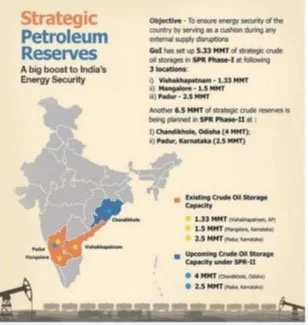
- Strategic Petroleum Reserves (SPR) are emergency crude oil storage systems maintained by countries to deal with:
- Wars,
- International crises,
- Oil shortages,
- Global supply disruptions,
- Sudden price spikes.
India stores crude oil in underground facilities to ensure continuous supply during emergencies.
KEY FEATURES OF THE AGREEMENT
Under the agreement:
- UAE will enhance participation in India’s SPR programme,
- UAE participation will increase to: 30 million barrels,
- Both countries will also cooperate in creating Strategic gas reserves in India.
Importance of the Agreement
The agreement is important because it:
- Strengthens India’s long-term energy security,
- Improves crisis preparedness,
- Reduces vulnerability to international supply shocks,
- Expands India’s energy storage capacity.
The agreement also supports:
- LNG infrastructure,
- LPG storage expansion,
- Long-term hydrocarbon cooperation.
OUTCOME 2: LONG TERM LPG SUPPLY AGREEMENT
Agreement Between:
- Indian Oil Corporation (IOCL)
- Abu Dhabi National Oil Company (ADNOC)
Importance of LPG Agreement
- LPG is an essential cooking fuel used by millions of Indian households.
Demand for LPG is increasing because:
- More families are shifting to clean cooking energy,
- Urbanisation is rising,
- Welfare schemes have expanded LPG access.
The agreement ensures:
- Stable LPG supply,
- Better domestic energy planning,
- Reduced risk of shortages,
- Long-term supply security.
It also reinforces UAE’s role as one of India’s most dependable energy partners.
OUTCOME 3: 5 BN USD INVESTMENT IN INDIA
- One of the biggest outcomes of the visit was the announcement of: $5 billion UAE investment package in India.
Breakdown of Investments
1. Emirates NBD Investment
- Emirates NBD will invest: $3 billion into: RBL Bank
2. ADIA–NIIF Infrastructure Investment
Abu Dhabi Investment Authority (
ADIA) will invest:
$1 billion along with: National Infrastructure and Investment Fund (
NIIF) for:
- Infrastructure projects,
- Strategic development initiatives.
3. International Holding Company Investment
- International Holding Company will invest: $1 billion into: Sammaan Capital
Importance of the Investment Package
The investments are important because they:
- Increase capital inflows into India,
- Support infrastructure development,
- Strengthen investor confidence,
- Boost economic growth,
- Generate employment opportunities.
The investments also reflect UAE’s:
- Long-term confidence in India’s economy,
- Commitment to India’s growth story.
OUTCOME 4: FRAMEWORK FOR STRATEGIC DEFENCE PARTNERSHIP
- India and UAE signed a: Framework for Strategic Defence Partnership Main Features of the Defence Framework
The agreement focuses on:
- Defence industrial cooperation,
- Joint defence production,
- Co-development of advanced technologies,
- Innovation partnerships,
- Maritime security,
- Cyber defence,
- Secure communication systems,
- Joint training and military exercises.
IMPORTANCE OF THE DEFENCE PARTNERSHIP
This framework supports India’s:
- Defence modernisation,
- Indigenous defence manufacturing,
- “Make in India” initiative,
- Strategic autonomy goals.
The partnership will also strengthen:
- Gulf maritime security,
- Regional stability,
- Defence technology cooperation.
OUTCOME 5: 8 EXAFLOP SUPERCOMPUTING CLUSTER
Partnership Between:
- Centre for Development of Advanced Computing (CDAC)
- G42
Meaning of Exaflop Supercomputer
- An Exaflop Supercomputer can perform: Quintillions of calculations per second.
- This is among the highest levels of computing power in the world.
Importance of the Project
The project will:
- Strengthen India’s AI ecosystem,
- Improve sovereign AI capabilities,
- Boost scientific research,
- Support cybersecurity and big data analysis,
- Enhance digital infrastructure.
Meaning of Sovereign AI Sovereign AI refers to:
- AI systems developed and controlled domestically,
- National ownership over strategic data,
- Reduced dependence on foreign digital systems.
This is increasingly important for:
- National security,
- Technological independence,
- Economic competitiveness.
OUTCOME 6: SHIP REPAIR CLUSTER AT VADINAR
Agreement Between:
- Cochin Shipyard Limited
- Drydocks World
Importance of the Project
The project will:
- Develop maritime infrastructure,
- Improve ship repair capabilities,
- Strengthen logistics networks,
- Enhance port connectivity,
- Support coastal industrialisation.
The project also supports: Make in India through:
- Domestic industrial development,
- Indigenous maritime capability building.
OUTCOME 7: SKILL DEVELOPMENT IN MARITIME SECTOR
A tripartite agreement was signed for:
- Maritime training,
- Technical upskilling,
- Shipbuilding expertise development.
Importance
The initiative supports:
- Employment generation,
- Skilled workforce creation,
- India’s emergence as a global maritime talent hub.
It also aligns with: Skill India Mission
OUTCOME 8: VIRTUAL TRADE CORRIDOR & MAITRI PLATFORM
- India and UAE welcomed the operationalisation of: Virtual Trade Corridor using: MAITRI digital framework
Purpose of MAITRI
The framework connects:
- Customs authorities,
- Ports,
- Trade systems of both countries.
Benefits
The initiative will:
- Reduce cargo delays,
- Lower logistics costs,
- Improve trade efficiency,
- Reduce transit time,
- Strengthen supply-chain connectivity.
ROLE OF CEPA
- The visit also strengthened implementation of: India–UAE Comprehensive Economic Partnership Agreement (CEPA)
CEPA has already helped:
- Increase bilateral trade,
- Improve market access,
- Boost investment cooperation.
OVERALL STRATEGIC IMPORTANCE
- The visit demonstrates that India–UAE relations are evolving from a traditional: Oil-based partnership into a: Future-oriented strategic partnership.
The relationship now includes:
- Energy security,
- AI and supercomputing,
- Defence manufacturing,
- Maritime infrastructure,
- Digital connectivity,
- Logistics,
- Investment,
- Skill development.
THE NETHERLANDS VISIT
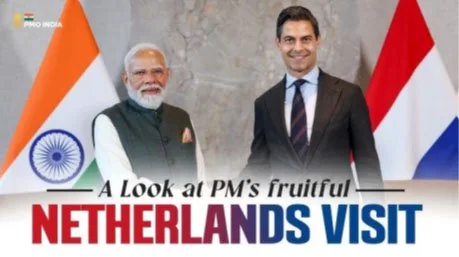
- PM Modi’s second visit to the Netherlands after 2017.
Main Areas of Cooperation
(a) Semiconductor Technology An agreement will be signed between:
Purpose:
To support a semiconductor fabrication plant in:
WHY SEMICONDUCTORS MATTER?
Semiconductors (chips) are used in:
- Mobile phones
- Cars
- Computers
- Defence equipment
- AI systems
India wants to become less dependent on imports from East Asia.
CLEAN ENERGY & WATER MANAGEMENT
(b) Clean Energy & Water Management
- PM Modi and Dutch PM visit: Afsluitdijk Dam
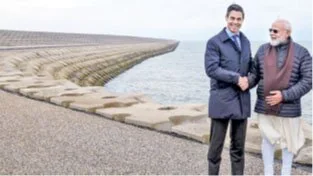
Focus Areas:
- Water management
- Hydrogen energy
- Sustainable fisheries
- Climate resilience
The Netherlands is globally famous for flood control and water technology.
(c) Trade & Investment
The Netherlands is:
- India’s largest export destination in Europe
- A major investor in India
Bilateral Trade:
 (d) Indian Community
The PM interacted with:
- NRIs
- Surinami Hindustani community
This is the largest Indian-origin group in mainland Europe.
THE SWEDEN VISIT
- PM Modi visited Sweden previously in 2018.
Why Sweden Is Important
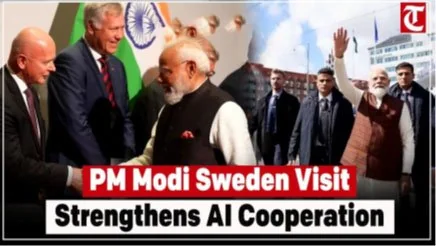
Sweden is a leader in:
- Innovation
- Research
- Green technology
- Telecommunications
- Defence manufacturing
KEY AREAS OF COOPERATION
(a) Technology & AI Corridor
- India and Sweden signed: SITAC (Sweden-India Technology and AI Corridor)
Areas Covered:
- AI
- Quantum computing
- 6G technology
- Life sciences
- Digital technology
(b) Defence Cooperation
Saab is building a manufacturing plant in:
Importance:
It is India’s first: 100% FDI-based defence manufacturing project
(c) Critical Minerals Partnership
Sweden has large deposits of critical minerals needed for:
- EV batteries
- Semiconductors
- Defence electronics
India wants secure supply chains for future industries.
(d) Green Investments
A Swedish company signed an investment agreement in Maharashtra for:
Worth: ₹1,990 crore
THE NORWAY VISIT
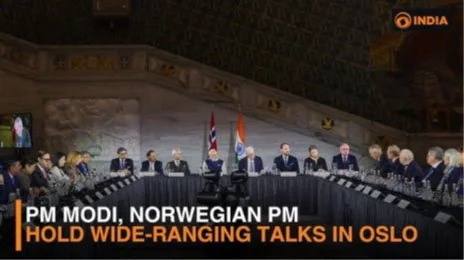
- This is the first standalone bilateral visit by an Indian PM to Norway in 43 years.
- PM Modi will also attend: Third India-Nordic Summit
WHY NORWAY MATTERS?
(a) India-EFTA Trade Agreement
- India signed a trade agreement with EFTA countries.
Full Form:
European Free Trade Association Countries include:
- Norway
- Switzerland
- Iceland
- Liechtenstein
Benefits:
- $100 billion investment commitment
- 1 million jobs expected over 15 years
(b) Maritime Cooperation
Indian shipyards are building ships for Norway.
Important agreement:
- Cochin Shipyard
- Kongsberg Maritime
(c) Polar & Space Cooperation ISRO Presence
- Indian Space Research Organisation antennas are operational in: Svalbard
Importance: Useful for:
- Satellite communication
- Arctic research
- Space missions
(d) Clean Energy
Norway is a major renewable energy producer.
Cooperation includes:
- Green shipping
- Renewable energy
- Sustainable transport
THE ITALY VISIT
- PM Modi visited Italy from May 19–21.

WHY ITALY IS IMPORTANT?
(a) IMEEC Corridor
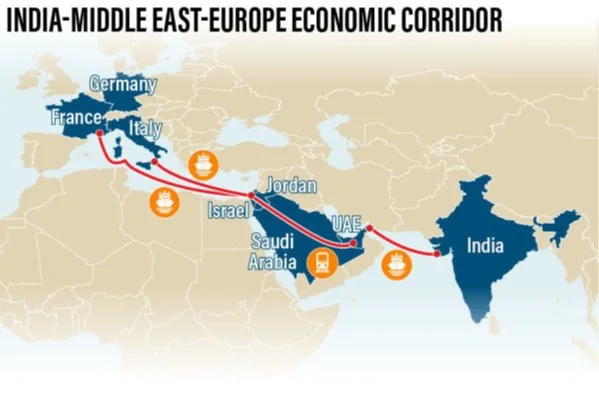
- Italy supports: IMEEC (India-Middle East-Europe Economic Corridor)
This project aims to improve:
- Trade routes
- Connectivity
- Energy transportation
- Supply chains
(b) Undersea Cable Project
A submarine cable linking India to Europe through Italy has become operational.
Benefits:
- Better internet connectivity
- Faster digital communication
- Data transfer security
 (c) Trade & Investment
Italy is India’s: 4th largest trading partner in the EU
Bilateral Trade:
(d) Major Tata Deal
- Tata Motors acquired: Iveco Group
Deal Value:
3.8 billion euros
This is one of the biggest Indian investments in Italy.
OUTCOMES
- Special Strategic Partnership: Both leaders elevated the bilateral relationship to mark deeper strategic alignment, with a focus on defense manufacturing, clean energy, and Indo-Pacific cooperation.
- Defence Industrial Roadmap: Paved the way for joint defense research, co-development, and co-production between the two nations.
- Technology & Trade: Collaborations were established in artificial intelligence, space cooperation, and critical minerals. Both nations agreed to foster cooperation under the principle of "Design and Develop in India and Italy, and Deliver for the World".
- Security Cooperation: Signed Memorandums of Understanding (MoUs) to curb tax crimes, money laundering, and terror financing.
- Worker Mobility: Formalized an agreement to facilitate the mobility and recruitment of Indian nurses and healthcare workers to Italy.
- Cultural & Scientific Exchange: Signed multiple MoUs expanding partnerships in agriculture, traditional medicine (Ayurveda), and educational research.
- FAO Recognition: PM Modi was honored with the prestigious FAO Agricola Medal by the United Nations' Food and Agriculture Organization.
Test your understanding
Questions from this article
Prelims practiceWith reference to PM MODI’S UAE & EUROPE TOUR, consider the following statements:
- Prime Minister Narendra Modi started a five-nation foreign tour on 15 May 2026.
- Countries Included: United Arab Emirates (UAE) Netherlands Norway Sweden Italy
- United Arab Emirates (UAE)
Which of the statements given above are correct?
- 1 and 2 only
- 2 and 3 only
- 1 and 3 only
- 1, 2 and 3
View answer
Answer: (d) 1, 2 and 3. All three statements are drawn from the article.
Mains practiceDiscuss the background, key issues and significance of PM MODI’S UAE & EUROPE TOUR for India.
Answer in 250 words.
View answer approach
- SIGNIFICANCE OF THE VISIT
- The visit took place during a period of:
- HISTORICAL BACKGROUND OF INDIA UAE TIES
- HISTORICAL TRADE TIES
- Historically, traders exchanged:
Frequently asked questionsFrequently asked questions
Why is Pm Modi’S Uae & Europe Tour in the news?
Background Prime Minister Narendra Modi started a five-nation foreign tour on 15 May 2026. Countries Included: United Arab Emirates (UAE) Netherlands Norway Sweden Italy The visit is happening during the ongoing Iran-West Asia conflict, which has created: Rising oil prices Supply chain disruptions Global energy uncertainty Prime Minister Narendra…
What are the key facts about Pm Modi’S Uae & Europe Tour?
SIGNIFICANCE OF THE VISIT A landmark Strategic Defence Partnership Framework, Major energy security agreements, A $5 billion UAE investment package for India, Cooperation in Artificial Intelligence (AI) and supercomputing, Maritime infrastructure agreements… The visit took place during a period of: Rising tensions in West Asia, The ongoing Iran conflict, Growing uncertainty in global energy markets, Supply-chain disruptions, And concerns over safe shipping routes in the Gulf region. Because India imports a large portion of its energy requirements from West Asia, the visit had major strategic and economic importance.
Why is Pm Modi’S Uae & Europe Tour important for UPSC preparation?
The topic connects current developments with Environment, Economy, International Relations and is relevant for both objective revision and analytical answer writing.