UPSC Current Affairs
NATIONAL MISSION FOR SUSTAINABLE AGRICULTURE
The Government of India highlighted the achievements of the National Mission for Sustainable Agriculture (NMSA), a major scheme that helps farmers deal with problems like: drought, floods, poor soil, water shortage, and climate change. The mission focuses on making Indian agriculture more sustainable, productive, and climate-resilient. SIMPLE MEANING OF NMSA The National Mission for Sustainable Agriculture (NMSA) was launched in 2014-15 under the National Action Plan on Climate Change (NAPCC).
VRAuthor Desk
3 min read
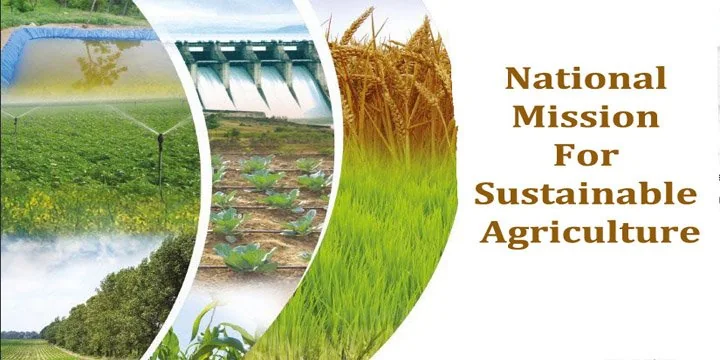
The Government of India highlighted the achievements of the National Mission for Sustainable Agriculture (NMSA), a major scheme that helps farmers deal with problems like: drought, floods, poor soil, water shortage, and climate change. The mission focuses on making Indian agriculture more sustainable, productive, and climate-resilient. SIMPLE MEANING OF NMSA The National Mission for Sustainable Agriculture (NMSA) was launched in 2014-15 under the National Action Plan on Climate Change (NAPCC).
Why is this in news?
The Government of India highlighted the achievements of the
National Mission for Sustainable Agriculture (NMSA), a major scheme that helps farmers deal with problems like:
- drought,
- floods,
- poor soil,
- water shortage, and
- climate change.
The mission focuses on making Indian agriculture more
sustainable,
productive, and
climate-resilient.
SIMPLE MEANING OF NMSA
- The National Mission for Sustainable Agriculture (NMSA) was launched in 2014-15 under the National Action Plan on Climate Change (NAPCC).
Its main goal is:
“To help farmers continue farming successfully even during climate change and extreme weather conditions.”
It especially supports:
- rainfed farming areas,
- better water use,
- healthy soil,
- climate-resilient crops, and
- modern farming methods.
WHY IS NMSA IMPORTANT?
- Around 60% of India’s farmland depends on rainfall.
- Rainfed farming contributes nearly 40% of total food production.
- Climate change is increasing:
- droughts,
- heat waves,
- floods,
- irregular rainfall.
So, India needs farming systems that can survive changing weather conditions.
MAJOR COMPONENTS OF NMSA
1: RAINFED AREA DEVELOPMENT
WHAT IS IT?
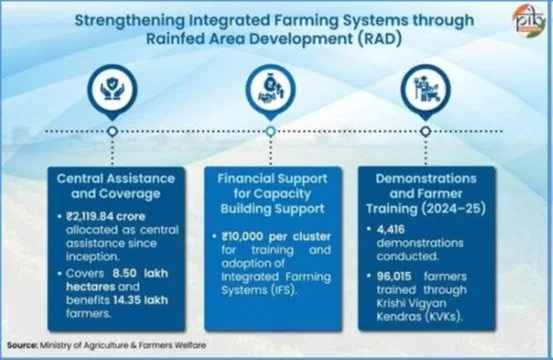
- This scheme helps farmers in rain-dependent areas adopt Integrated Farming Systems (IFS).
- Integrated Farming System (IFS) means:
Instead of depending on only one crop, farmers combine:
- crops,
- vegetables,
- livestock,
- fisheries,
- horticulture, etc.
This reduces risk and increases income.
Benefits
- Better income stability
- Less dependence on one crop
- Protection during bad weather
- More employment opportunities
Key Achievements
- ₹2,119.84 crore released since 2014-15
- 5 lakh hectares covered
- 35 lakh farmers benefited
- In 2025-26:
- ₹343.86 crore allocated
- 96,013 farmers trained
2: PER DROP MORE CROP
Main Aim:
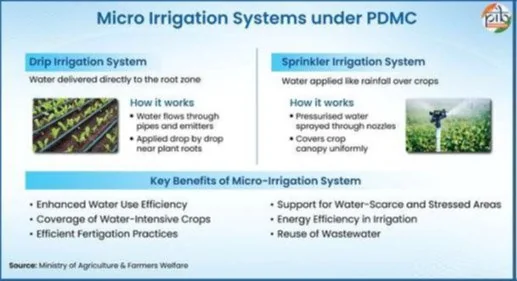
- To save water in farming through micro-irrigation.
Types of Micro-Irrigation
(a) Drip Irrigation
- Water is supplied directly to plant roots drop by drop.
(b) Sprinkler Irrigation
- Water is sprayed like rainfall through pipes and nozzles.
Why is it important?
- Saves water
- Reduces wastage
- Increases crop productivity
- Useful in water-scarce areas
Achievements
- Started in 2015-16
- Around 109 lakh hectares covered
- ₹26,325 crore central assistance released
Future Target
Government plans to cover:
- 100 lakh hectares more between 2025-26 and 2029-30
3: SOIL HEALTH MANAGEMENT
Aim:
- To improve soil fertility and encourage balanced use of fertilizers.
Focus Areas
- Soil testing
- Organic farming
- Reducing excessive fertilizer use
- Preventing soil erosion
Healthy soil leads to:
- better crop production,
- lower farming costs,
- long-term sustainability.
SOIL HEALTH CARD SCHEME
What is it?
Farmers receive a
Soil Health Card after soil testing.
The card tells:
- which nutrients are lacking,
- how much fertilizer is needed,
- which crops are suitable.
Benefits
- Balanced fertilizer use
- Reduced overuse of urea
- Better productivity
- Improved soil quality
Achievements
- Started in 2015
- 79 crore Soil Health Cards generated
- In 2025-26:
- 53 lakh soil samples collected
- 87 lakh samples tested
NITI Aayog Findings
- 5% farmers saw major improvement in soil health
- Excessive urea use reduced
Soil Fertility Maps
- The government is also preparing village-level soil fertility maps.
Purpose
These maps help farmers know:
- nutrient condition of their land,
- proper fertilizer requirements.
Progress
- 6,954 model villages identified
- Mapping completed in 2,023 villages
ROLE OF ICAR & NICRA
ICAR
- The Indian Council of Agricultural Research conducts agricultural research in India.
NICRA
- The National Innovations on Climate Resilient Agriculture (NICRA) programme was launched in 2011.
Main Work
- Develop climate-resilient farming technologies
- Train farmers
- Prepare for extreme weather events
Achievements
- Vulnerability studies conducted in 651 districts
- 310 districts found highly vulnerable
- Climate Resilient Villages created in:
- 448 villages
- across 151 districts
CLIMATE RESILIENT CROP VARIETIES
Between 2014 and 2025:
- 2,996 climate-resilient crop varieties were released.
These crops can better tolerate:
- drought,
- heat,
- floods,
- changing climate conditions.
CONNECTION WITH SDGs
| SDG |
Contribution |
| SDG 2 – Zero Hunger |
Improves food production |
| SDG 6 – Clean Water |
Saves water through micro-irrigation |
| SDG 13 – Climate Action |
Helps farmers adapt to climate change |
- Prelims: Key facts, institutions, locations and terminology in the article.
- Mains: Connect the topic with Environment, Economy, Polity & Governance.
- Revision: Use the article headings to prepare concise notes and answer-writing points.
Test your understanding
Questions from this article
Prelims practiceWith reference to NATIONAL MISSION FOR SUSTAINABLE AGRICULTURE, consider the following statements:
- The National Mission for Sustainable Agriculture (NMSA) was launched in 2014-15 under the National Action Plan on Climate Change (NAPCC).
- climate-resilient crops, and
- Around 60% of India’s farmland depends on rainfall.
Which of the statements given above are correct?
- 1 and 2 only
- 2 and 3 only
- 1 and 3 only
- 1, 2 and 3
View answer
Answer: (d) 1, 2 and 3. All three statements are drawn from the article.
Mains practiceDiscuss the background, key issues and significance of NATIONAL MISSION FOR SUSTAINABLE AGRICULTURE for India.
Answer in 250 words.
View answer approach
- SIMPLE MEANING OF NMSA
- WHY IS NMSA IMPORTANT?
- MAJOR COMPONENTS OF NMSA
- 1: RAINFED AREA DEVELOPMENT
- WHAT IS IT?
Frequently asked questionsFrequently asked questions
Why is National Mission For Sustainable Agriculture in the news?
The Government of India highlighted the achievements of the National Mission for Sustainable Agriculture (NMSA), a major scheme that helps farmers deal with problems like: drought, floods, poor soil, water shortage, and climate change. The mission focuses on making Indian agriculture more sustainable, productive, and climate-resilient.
What are the key facts about National Mission For Sustainable Agriculture?
SIMPLE MEANING OF NMSA The National Mission for Sustainable Agriculture (NMSA) was launched in 2014-15 under the National Action Plan on Climate Change (NAPCC). Its main goal is: “To help farmers continue farming successfully even during climate change and extreme weather conditions.” It especially supports: rainfed farming areas, better water use, healthy soil, climate-resilient crops, and modern farming methods. Around 60% of India’s farmland depends on rainfall.
Why is National Mission For Sustainable Agriculture important for UPSC preparation?
The topic connects current developments with Environment, Economy, Polity & Governance and is relevant for both objective revision and analytical answer writing.