UPSC Current Affairs
MASROOR ROCK CUT TEMPLES
The Masroor Rock-Cut Temples of Himachal Pradesh have recently gained attention for their unique architecture and heritage value. They are often called the "Ellora of Himachal Pradesh" and the "Himalayan Pyramid". ABOUT THE TEMPLES An 8th-century rock-cut Hindu temple complex located in Kangra Valley on the banks of the Beas River in Himachal Pradesh.
VRAuthor Desk
2 min read
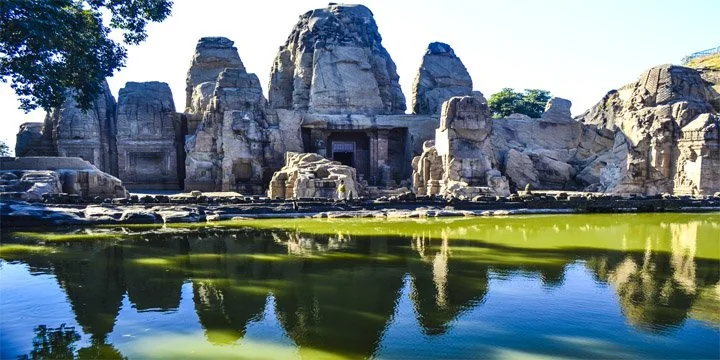
The Masroor Rock-Cut Temples of Himachal Pradesh have recently gained attention for their unique architecture and heritage value. They are often called the "Ellora of Himachal Pradesh" and the "Himalayan Pyramid". ABOUT THE TEMPLES An 8th-century rock-cut Hindu temple complex located in Kangra Valley on the banks of the Beas River in Himachal Pradesh.
Why in News?
- The Masroor Rock-Cut Temples of Himachal Pradesh have recently gained attention for their unique architecture and heritage value.
- They are often called the "Ellora of Himachal Pradesh" and the "Himalayan Pyramid".
ABOUT THE TEMPLES
- An 8th-century rock-cut Hindu temple complex located in Kangra Valley on the banks of the Beas River in Himachal Pradesh.
- Consists of 15 monolithic rock-cut temples carved from a single rock.
- Dedicated to Lord Shiva, Lord Rama, Goddess Sita, and Lord Lakshmana.
HISTORICAL BACKGROUND
- Believed to have been built around the 8th century CE.
- Shows strong influence of Gupta-style architecture.
- No clear mention of the temple exists in ancient scriptures or historical records.
- First reported by Henry Shuttleworth (1913).
- Surveyed by Archaeological Survey of India (ASI) officer Harold Hargreaves (1915).
ARCHITECTURAL FEATURES
- Built in the North Indian Nagara style of temple architecture.
- Entire complex is carved out of a single monolithic rock.
- Follows a symmetrical square-grid layout.
- Main temple is surrounded by smaller shrines arranged in a Mandala pattern.
- Features prominent Shikharas (temple towers).
- Has a sacred water tank in front of the temple complex.
UNIQUE FEATURES
- Unlike most Hindu temples that face east, Masroor Temples face northeast towards the Dhauladhar Mountains.
- Has three entrances facing:
- Northeast
- Southeast
- Northwest
- Evidence suggests a fourth entrance was planned but left incomplete.
SCULPTURAL SIGNIFICANCE
- Contains elaborate carvings of Vedic and Puranic deities.
- Features relief sculptures and friezes depicting stories from Hindu mythology.
- Reflects the rich artistic and religious traditions of ancient India.
Damage and Conservation
- Large parts of the sculptures and carvings have been damaged over time.
- Repeated earthquakes in the Himalayan region are believed to be the main cause of destruction.
- Several original sculptures and decorative elements have been lost.
OVERALL SIGNIFICANCE
- One of India's rare examples of rock-cut Nagara-style temple architecture.
- Important centre of Hindu religious and cultural heritage.
- Represents advanced engineering and artistic excellence of early medieval India.
- Holds immense archaeological, historical and tourism value.
- Prelims: Key facts, institutions, locations and terminology in the article.
- Mains: Connect the topic with Environment, Economy.
- Revision: Use the article headings to prepare concise notes and answer-writing points.
Test your understanding
Questions from this article
Prelims practiceWith reference to MASROOR ROCK CUT TEMPLES, consider the following statements:
- The Masroor Rock-Cut Temples of Himachal Pradesh have recently gained attention for their unique architecture and heritage value.
- They are often called the "Ellora of Himachal Pradesh" and the "Himalayan Pyramid".
- An 8th-century rock-cut Hindu temple complex located in Kangra Valley on the banks of the Beas River in Himachal Pradesh.
Which of the statements given above are correct?
- 1 and 2 only
- 2 and 3 only
- 1 and 3 only
- 1, 2 and 3
View answer
Answer: (d) 1, 2 and 3. All three statements are drawn from the article.
Mains practiceDiscuss the background, key issues and significance of MASROOR ROCK CUT TEMPLES for India.
Answer in 250 words.
View answer approach
- Why in News?
- ABOUT THE TEMPLES
- HISTORICAL BACKGROUND
- ARCHITECTURAL FEATURES
- UNIQUE FEATURES
Frequently asked questionsFrequently asked questions
Why is Masroor Rock Cut Temples in the news?
The Masroor Rock-Cut Temples of Himachal Pradesh have recently gained attention for their unique architecture and heritage value. They are often called the "Ellora of Himachal Pradesh" and the "Himalayan Pyramid".
What are the key facts about Masroor Rock Cut Temples?
ABOUT THE TEMPLES An 8th-century rock-cut Hindu temple complex located in Kangra Valley on the banks of the Beas River in Himachal Pradesh. Consists of 15 monolithic rock-cut temples carved from a single rock. Dedicated to Lord Shiva, Lord Rama, Goddess Sita, and Lord Lakshmana.
Why is Masroor Rock Cut Temples important for UPSC preparation?
The topic connects current developments with Environment, Economy and is relevant for both objective revision and analytical answer writing.