UPSC Current Affairs
MAHARASHTRA EARTHQUAKE SWARM
Maharashtra has experienced a series of small earthquakes over the last fortnight. Around 29 tremors were reported: 24 in and around Nashik 4 in Palghar 1 in Nagpur The strongest tremor was recorded in Nagpur on 8 August, with a magnitude of 4.3. Most of the earthquakes were shallow, occurring at depths of around 5–8 km.
VRAuthor Desk
5 min read

Maharashtra has experienced a series of small earthquakes over the last fortnight. Around 29 tremors were reported: 24 in and around Nashik 4 in Palghar 1 in Nagpur The strongest tremor was recorded in Nagpur on 8 August, with a magnitude of 4.3. Most of the earthquakes were shallow, occurring at depths of around 5–8 km.
Why in News?
- Maharashtra has experienced a series of small earthquakes over the last fortnight.
- Around 29 tremors were reported:
- 24 in and around Nashik
- 4 in Palghar
- 1 in Nagpur
- The strongest tremor was recorded in Nagpur on 8 August, with a magnitude of 4.3.
- Most of the earthquakes were shallow, occurring at depths of around 5–8 km.
- Since there was no clear mainshock and several earthquakes of comparable magnitude occurred over a period of time, seismologists describe this pattern as an earthquake swarm.
WHAT IS AN EARTHQUAKE?
- An earthquake is the sudden movement of rocks along a fault or zone of weakness in the Earth's crust.
- Rocks can remain locked because of friction even when forces are acting on them.
- As stress continues to build, the rocks may eventually slip and release stored energy as seismic waves.
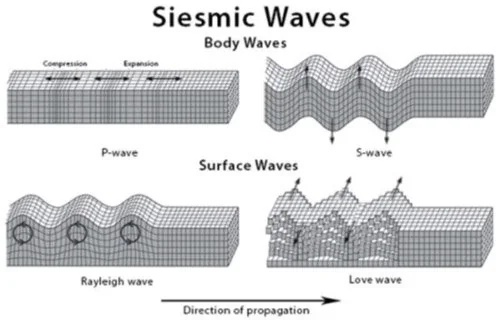
MAJOR TYPES OF SEISMIC WAVES
- P Waves: Compress and stretch rocks in the direction in which the waves travel.
- S Waves: Move rocks sideways through a shearing motion.
- Surface Waves: Travel along the Earth's surface.
- The combined movement of these waves produces the shaking experienced at the surface.
WHAT IS AN EARTHQUAKE SWARM?
- In a normal earthquake sequence, a major mainshock is usually followed by smaller aftershocks.
- In an earthquake swarm, there is no clearly identifiable mainshock.
- Instead, several earthquakes of relatively comparable magnitude occur over days or even longer periods.
- Their magnitudes can fluctuate during the swarm.
Important Point
- An earthquake swarm does not necessarily mean that a larger earthquake is about to occur.
- Different earthquake swarms can have different causes.
Examples
- Palghar, Maharashtra: Experienced a major earthquake swarm beginning in November 2018, with thousands of earthquakes continuing for more than a year.
- More short-duration seismic activity has also been recorded in the region in subsequent years.
- Campi Flegrei, Italy: A major seismic swarm occurred in mid-2024. On 20 May, more than 150 earthquakes were recorded within a few hours, including a magnitude 4.4 earthquake, the strongest in the region in four decades.
WHY DOES MAHARASHTRA EXPERIENCE EARTHQUAKE SWARMS?
1. Intraplate Location
- Maharashtra lies far from a major tectonic plate boundary.
- Therefore, many earthquakes occurring in the State are classified as intraplate earthquakes.
- Such earthquakes occur within a tectonic plate, rather than at its boundary.
2. Deccan Traps
- Much of Maharashtra lies on the Deccan Plateau.
- Its bedrock mainly consists of extensive basaltic lava flows, known as the Deccan Traps.
- These formations were created around 66 million years ago when huge quantities of lava erupted through fissures in western-central India.
- Thousands of individual lava flows accumulated over time, in some places reaching hundreds of metres in thickness.
- After solidification, these basalt layers developed fractures and other weaknesses.
- Such structures can transmit accumulated tectonic stress in ways similar to faults.
3. Continuing Movement of the Indian Plate
- The Indian Plate continues to move and deform.
- This movement generates and accumulates stresses even in the interior of the plate.
- Since the Deccan Plateau lies within the Indian Plate, these stresses can activate existing fractures and structures.
4. Local Geological Structures
- Studies around Nashik have identified geological structures such as:
- These structures can contribute to local seismic activity.
WHAT ROLE DOES WATER PLAY IN EARTHQUAKE?
Rainfall-Triggered Seismicity
- Water can move deeper underground through:
- Soil
- Fractures
- Permeable rocks
- If water reaches a network of cracks connected to a fault, it can increase pore pressure.
- Increased pore pressure can reduce the stability of rocks and contribute to fault movement.
- When rainfall-induced water movement triggers earthquakes, the phenomenon is called rainfall-triggered seismicity.
EVIDENCE FROM PALGHAR
- Researchers studying the 2018 Palghar earthquake swarm using satellite data found evidence of land subsidence.
- They suggested that rainwater entering the subsurface could have helped trigger faults.
- A detailed study of more than 21,000 earthquakes recorded between January 2019 and October 2020 found that seismic activity increased following rainfall.
- The study suggested that water migrated through cracks and fissures, increasing pore pressure and helping drive the earthquake swarm.
BUT RAINFALL IS NOT THE ONLY EXPLANATION
- Other studies have given different views about the importance of rainfall.
- Possible contributing factors include:
- Normal faulting
- Aseismic deformation
- Tectonic stresses
- Existing geological structures and fractures
Aseismic deformation refers to gradual movement or deformation of the Earth's crust that does not produce a detectable earthquake
Koyna: Reservoir-Triggered Seismicity
- Maharashtra's Koyna-Warna reservoir region is a famous example of reservoir-triggered seismicity.
- Scientists have observed earthquakes in the region for decades.
1967 Koyna Earthquake
- On 10 December 1967, a magnitude 6.3 earthquake occurred southwest of the Koyna Dam.
- It caused extensive damage in Koynanagar.
- Houses were destroyed and more than 200 people were killed.
- Such a major earthquake was unprecedented in the region.
Link with the Reservoir
- There was reportedly no recorded seismicity in the region before construction of the dam began in 1956.
- The Koyna reservoir was filled in 1962.
- Seismic activity began after the reservoir was filled and could be detected at the seismological station in Pune, around 120 km away.
- Minor seismic activity eventually culminated in the 1967 Koyna earthquake.
- Prelims: Key facts, institutions, locations and terminology in the article.
- Mains: Connect the topic with Environment, Economy, Defence.
- Revision: Use the article headings to prepare concise notes and answer-writing points.
Test your understanding
Questions from this article
Prelims practiceWith reference to MAHARASHTRA EARTHQUAKE SWARM, consider the following statements:
- Maharashtra has experienced a series of small earthquakes over the last fortnight.
- Around 29 tremors were reported: 24 in and around Nashik 4 in Palghar 1 in Nagpur
- The strongest tremor was recorded in Nagpur on 8 August, with a magnitude of 4.3.
Which of the statements given above are correct?
- 1 and 2 only
- 2 and 3 only
- 1 and 3 only
- 1, 2 and 3
View answer
Answer: (d) 1, 2 and 3. All three statements are drawn from the article.
Mains practiceDiscuss the background, key issues and significance of MAHARASHTRA EARTHQUAKE SWARM for India.
Answer in 250 words.
View answer approach
- Why in News?
- WHAT IS AN EARTHQUAKE?
- MAJOR TYPES OF SEISMIC WAVES
- WHAT IS AN EARTHQUAKE SWARM?
- WHY DOES MAHARASHTRA EXPERIENCE EARTHQUAKE SWARMS?
Frequently asked questionsFrequently asked questions
Why is Maharashtra Earthquake Swarm in the news?
Maharashtra has experienced a series of small earthquakes over the last fortnight. Around 29 tremors were reported: 24 in and around Nashik 4 in Palghar 1 in Nagpur The strongest tremor was recorded in Nagpur on 8 August, with a magnitude of 4.3.
What are the key facts about Maharashtra Earthquake Swarm?
Most of the earthquakes were shallow, occurring at depths of around 5–8 km. Since there was no clear mainshock and several earthquakes of comparable magnitude occurred over a period of time, seismologists describe this pattern as an earthquake swarm. An earthquake is the sudden movement of rocks along a fault or zone of weakness in the Earth's crust.
Why is Maharashtra Earthquake Swarm important for UPSC preparation?
The topic connects current developments with Environment, Economy, Defence and is relevant for both objective revision and analytical answer writing.