UPSC Current Affairs
KARNATAKA HC VERDICT ON SHARAVATI PUMPED STORAGE HYDROELECTRIC PROJECT
The Karnataka High Court issued a notice to the Central Government and Karnataka State Government on a Public Interest Litigation (PIL) challenging approvals granted for the ₹10,000 crore Sharavathi Pumped Storage Hydroelectric Project. The petition questions the legality of approvals given by: State Wildlife Board Standing Committee of the National Board for Wildlife (NBWL) The project is proposed in Shivamogga and Uttara Kannada districts of Karnataka. REASON FOR THE PETITION The petitioners argue that the project violates provisions of the Wildlife (Protection) Act, 1972.
VRAuthor Desk
5 min read
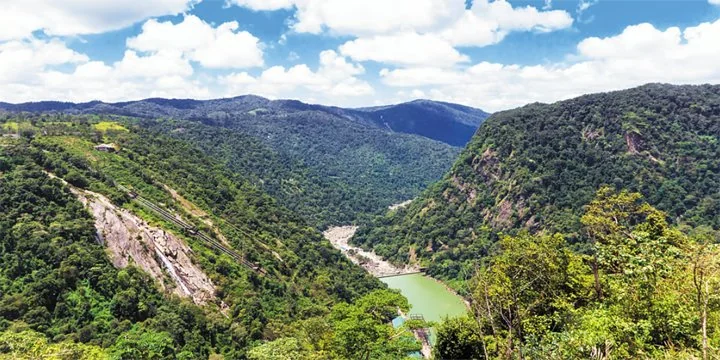
The Karnataka High Court issued a notice to the Central Government and Karnataka State Government on a Public Interest Litigation (PIL) challenging approvals granted for the ₹10,000 crore Sharavathi Pumped Storage Hydroelectric Project. The petition questions the legality of approvals given by: State Wildlife Board Standing Committee of the National Board for Wildlife (NBWL) The project is proposed in Shivamogga and Uttara Kannada districts of Karnataka. REASON FOR THE PETITION The petitioners argue that the project violates provisions of the Wildlife (Protection) Act, 1972.
Why in News?
- The Karnataka High Court issued a notice to the Central Government and Karnataka State Government on a Public Interest Litigation (PIL) challenging approvals granted for the ₹10,000 crore Sharavathi Pumped Storage Hydroelectric Project.
- The petition questions the legality of approvals given by:
- State Wildlife Board
- Standing Committee of the National Board for Wildlife (NBWL)
- The project is proposed in Shivamogga and Uttara Kannada districts of Karnataka.
REASON FOR THE PETITION
- The petitioners argue that the project violates provisions of the Wildlife (Protection) Act, 1972.
- According to the petition:
- The project is located within the Sharavathi Valley Lion-Tailed Macaque Sanctuary
- A part of the project area lies inside the Eco-Sensitive Zone (ESZ) of the sanctuary
- Petitioners claim the project could cause serious damage to wildlife habitats.
RELEVANT LAW: SECTION 29 OF THE WILDLIFE PROTECTION ACT, 1972
- Section 29 of the Act states that:
- No person shall destroy, exploit or remove wildlife or forest produce from a sanctuary
- No activity should damage or divert wildlife habitat
- Flow of water into or out of the sanctuary cannot be altered
- Such actions can only be allowed with permission from the Chief Wildlife Warden and must be justified for the improvement and management of wildlife in the sanctuary.
- The petitioners argue that the current project does not benefit wildlife conservation.
LAND AREA INVOLVED IN THE PROJECT
According to the petition:
- Total land required: 763 hectares
Break-up:
- 102 hectares inside the wildlife sanctuary
- 715 hectares inside the Eco-Sensitive Zone (ESZ)
This raises concerns about
habitat destruction and ecological damage.
ABOUT THE SHARAVATHI PUMPED STORAGE HYDROELECTRIC PROJECT
- The project is a Pumped Storage Hydropower Project (PSHP) proposed on the Sharavathi River in Karnataka.
- Key details:
- Planned capacity: 2,000 MW
- Estimated cost: ₹10,000 crore
- Developed by Karnataka Power Corporation Limited (KPCL)
- If completed, it would become India’s largest pumped storage hydropower project.
HOW PUMPED STORAGE HYDROPOWER WORKS?
- A pumped storage power plant uses two reservoirs at different heights.
- Working mechanism:
- During low electricity demand, water is pumped from the lower reservoir to the upper reservoir
- During high electricity demand, water flows back down through turbines
- The flowing water generates electricity
- This technology helps store energy and stabilise power supply, especially with renewable energy sources.
RESERVOIRS USED IN THE PROJECT
The project will use
two existing dams:
Talakalale Dam
- Height: 48 metres
- Will function as the upper reservoir
Gerusoppa Dam
- Height: 64 metres
- Will function as the lower reservoir
Additional infrastructure includes:
- Five tunnels
- Eight pumping stations
ENVIRONMENTAL CONCERNS
- The project area lies within the Western Ghats, a globally recognised biodiversity hotspot.
- The Sharavathi Wildlife Sanctuary is home to several rare species, including:
- Lion-tailed macaque (endangered)
- Hornbills
- King cobras
- Several endemic plant species
- Environmentalists argue the project could threaten these fragile ecosystems.
ABOUT THE SHARAVATHI RIVER
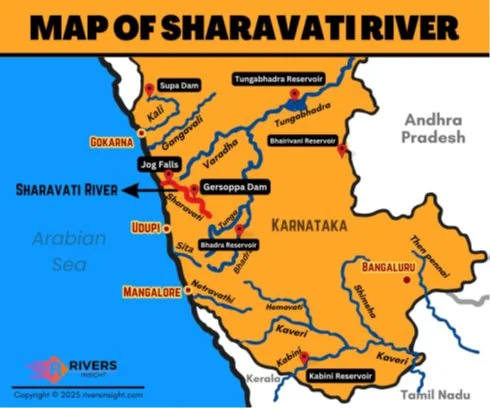
- The Sharavathi River is located in Karnataka.
- Key facts:
- One of the few west-flowing rivers in India
- Originates in the Western Ghats
- Flows northwest and drains into the Arabian Sea at Honnavar
- Total length: 128 km
- The river forms the famous Jog Falls, one of the highest waterfalls in India.
- Height of the falls: 253 metres.
 MAJOR TRIBUTARIES OF SHARAVATHI
Important tributaries include:
- Nandihole
- Haridravathi
- Mavinahole
- Hilkunji
- Yennehole
- Hurlihole
- Nagodihole
ABOUT NATIONAL BOARD FOR WILDLIFE
- The National Board for Wildlife (NBWL) is a statutory body established by the Central Government in 2003.
- It was constituted under Section 5A of the Wildlife (Protection) Act, 1972.
- NBWL serves as the top advisory body in India on wildlife conservation.
- It advises the government on issues related to:
- Wildlife protection
- Management of Protected Areas (PAs)
- Approval of development projects in wildlife habitats
ROLE & IMPORTANCE OF NBWL
The
National Board for Wildlife guides the government in making decisions related to:
- Wildlife conservation policies
- Protection of biodiversity
- Development projects in protected areas
It plays a key role in ensuring that
development activities do not harm wildlife ecosystems.
ORGANISATIONAL STRUCTURE
The
NBWL is a 47-member body.
Leadership
- Chairperson: Prime Minister of India
- Vice-Chairperson: Union Minister of Environment, Forest and Climate Change
Members Include
- Chief of Army Staff
- Defence Secretary
- Expenditure Secretary of the Government of India
- Representatives from wildlife and conservation institutions
In addition, the government nominates:
- 10 eminent conservationists, ecologists and environmentalists
MEMBER SECRETARY OF NBWL
- The Additional Director General of Forests (Wildlife) and Director of Wildlife Preservation serves as the Member Secretary of the Board.
- The Member Secretary helps in:
- Coordinating meetings
- Implementing board decisions
- Managing administrative functions
MAJOR FUNCTIONS OF NBWL
- The main functions of the National Board for Wildlife include:
- Wildlife Conservation
- Advising the Central and State Governments on matters related to wildlife protection.
- Recommending strategies to control poaching and illegal wildlife trade.
- Protected Area Management
- Providing recommendations for:
- National Parks
- Wildlife Sanctuaries
- Other Protected Areas
- Environmental Impact Assessment
- Monitoring Conservation Efforts
- Preparing and publishing a Wildlife Status Report at least once every two years.
STANDING COMMITTEE OF NBWL
- The Standing Committee is a smaller body formed under the NBWL.
- Composition
- Consists of not more than 10 members
- Chairperson: Union Minister of Environment, Forest and Climate Change
ROLE OF THE STANDING COMMITTEE
- The Standing Committee mainly deals with project approvals in protected areas.
Its functions include:
- Examining development projects in wildlife sanctuaries
- Regulating land diversion in protected areas
- Reviewing activities within Eco-Sensitive Zones (ESZs)
- Thus, it acts as a project clearance authority.
DIFFERENCE BETWEEN NBWL & STANDING COMMITTEE OF NBWL
| Aspect |
National Board for Wildlife (NBWL) |
Standing Committee of NBWL |
| Nature |
Policy-level advisory body |
Project clearance body |
| Leadership |
Chaired by Prime Minister |
Chaired by Environment Minister |
| Role |
Wildlife conservation policy and strategy |
Approves projects in Protected Areas and ESZs |
| Size |
47 members |
Up to 10 members |
- Prelims: Key facts, institutions, locations and terminology in the article.
- Mains: Connect the topic with Environment, Economy, Defence.
- Revision: Use the article headings to prepare concise notes and answer-writing points.
Test your understanding
Questions from this article
Prelims practiceWith reference to KARNATAKA HC VERDICT ON SHARAVATI PUMPED STORAGE HYDROELECTRIC PROJECT, consider the following statements:
- The Karnataka High Court issued a notice to the Central Government and Karnataka State Government on a Public Interest Litigation (PIL) challenging approvals granted for the ₹10,000 crore Sharavathi Pumped Storage…
- The petition questions the legality of approvals given by: State Wildlife Board Standing Committee of the National Board for Wildlife (NBWL)
- Standing Committee of the National Board for Wildlife (NBWL)
Which of the statements given above are correct?
- 1 and 2 only
- 2 and 3 only
- 1 and 3 only
- 1, 2 and 3
View answer
Answer: (d) 1, 2 and 3. All three statements are drawn from the article.
Mains practiceDiscuss the background, key issues and significance of KARNATAKA HC VERDICT ON SHARAVATI PUMPED STORAGE HYDROELECTRIC PROJECT for India.
Answer in 250 words.
View answer approach
- Why in News?
- REASON FOR THE PETITION
- RELEVANT LAW: SECTION 29 OF THE WILDLIFE PROTECTION ACT, 1972
- ABOUT THE SHARAVATHI PUMPED STORAGE HYDROELECTRIC PROJECT
- HOW PUMPED STORAGE HYDROPOWER WORKS?
Frequently asked questionsFrequently asked questions
Why is Karnataka Hc Verdict On Sharavati Pumped Storage Hydroelectric Project in the news?
The Karnataka High Court issued a notice to the Central Government and Karnataka State Government on a Public Interest Litigation (PIL) challenging approvals granted for the ₹10,000 crore Sharavathi Pumped Storage Hydroelectric Project. The petition questions the legality of approvals given by: State Wildlife Board Standing Committee of the National Board for Wildlife (NBWL) The project is proposed in Shivamogga and Uttara Kannada districts of Karnataka.
What are the key facts about Karnataka Hc Verdict On Sharavati Pumped Storage Hydroelectric Project?
REASON FOR THE PETITION The petitioners argue that the project violates provisions of the Wildlife (Protection) Act, 1972. According to the petition: The project is located within the Sharavathi Valley Lion-Tailed Macaque Sanctuary A part of the project area lies inside the Eco-Sensitive Zone (ESZ) of the sanctuary Petitioners claim the project could cause serious damage to… RELEVANT LAW: SECTION 29 OF THE WILDLIFE PROTECTION ACT, 1972 Section 29 of the Act states that: No person shall destroy, exploit or remove wildlife or forest produce from a sanctuary No activity should damage or divert wildlife habitat Flow of water into or…
Why is Karnataka Hc Verdict On Sharavati Pumped Storage Hydroelectric Project important for UPSC preparation?
The topic connects current developments with Environment, Economy, Defence and is relevant for both objective revision and analytical answer writing.