UPSC Current Affairs
GREAT NICOBAR ISLAND DEVELOPMENT PROJECT
The Government of India has approved a ₹13,000 crore Greenfield Civil-Military Airport in Great Nicobar Island. The airport will be developed near Galathea Bay under the larger ₹81,000 crore Great Nicobar Island Development Project. The government has decided not to expand INS Baaz, the existing naval air station at Campbell Bay.
VRAuthor Desk
5 min read
The Government of India has approved a ₹13,000 crore Greenfield Civil-Military Airport in Great Nicobar Island. The airport will be developed near Galathea Bay under the larger ₹81,000 crore Great Nicobar Island Development Project. The government has decided not to expand INS Baaz, the existing naval air station at Campbell Bay.
Why in News?
- The Government of India has approved a ₹13,000 crore Greenfield Civil-Military Airport in Great Nicobar Island.
- The airport will be developed near Galathea Bay under the larger ₹81,000 crore Great Nicobar Island Development Project.
- The government has decided not to expand INS Baaz, the existing naval air station at Campbell Bay.
- The project has triggered debate over its strategic benefits, environmental impact, and tribal rights concerns.
KEY DECISION: NEW GREENFIELD CIVIL MILITARY AIRPORT
Location
- Chingen, near Galathea Bay.
- Southeastern coast of Great Nicobar Island.
Cost
- Approximately ₹13,000 crore.
Timeline
- Expected completion within 5 years.
Operational Structure
- Will function as a dual-use airport.
- Serve both:
- Civilian aviation.
- Military operations.
- Will remain under Indian Navy operational control.
WHY WAS INS BAAZ EXPANSION DROPPED?
Earlier Proposal
- Expansion of runway at INS Baaz in Campbell Bay.
- Existing runway length: 4,500 feet.
- Proposed expansion: Around 10,000 feet.
REASONS FOR REJECTION
Terrain Constraints
- Difficult geographical conditions.
- Limited availability of land.
Navigational Challenges
- Operational difficulties due to surrounding terrain.
Infrastructure Limitations
- Large supporting infrastructure required.
Environmental Concerns
Expansion could have led to:
- Greater forest diversion.
- Disturbance to wildlife habitats.
- Impact on tribal settlements.
Government Assessment
- Greenfield airport considered more feasible.
- Better scope for future expansion.
WHY GREAT NICOBAR MATTERS?
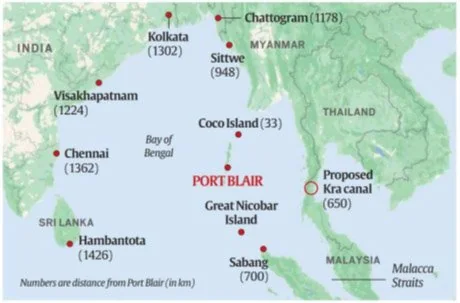
Strategic Location
- India's southernmost island.
- Located in the Andaman and Nicobar archipelago.
- Positioned near major international sea routes.
PROXIMITY WITH STRAIT OF MALACCA
Importance
- One of the world's busiest maritime chokepoints.
- Connects:
- Indian Ocean.
- South China Sea.
- Pacific Ocean.
Significance
- Large share of global trade passes through it.
- Major route for oil and energy shipments.
- Critical for international supply chains.
Six Degree Channel
- Great Nicobar lies close to the Six Degree Channel.
- Important sea route leading into the Malacca Strait.
 STRATEGIC VALUE
Enables India to:
- Monitor maritime traffic.
- Track naval movements.
- Strengthen maritime surveillance.
- Protect Sea Lines of Communication (SLOCs).
STRATEGIC SIGNIFICANCE FOR INDIA
Strengthening Indo-Pacific Presence
The project will help India:
- Expand its strategic footprint.
- Enhance influence in the Indo-Pacific.
- Improve maritime domain awareness.
Military Advantages
Enhanced Surveillance
- Better monitoring of Indian Ocean shipping routes.
- Improved tracking of military activities.
Increased Operational Reach
- Faster deployment of aircraft and troops.
- Improved logistics support.
Disaster Response
- Quicker humanitarian assistance and disaster relief operations.
Countering Chinese Presence
The project is expected to:
- Strengthen India's position in the Indian Ocean Region (IOR).
- Respond to increasing Chinese maritime activity.
- Improve strategic deterrence capabilities.
EXISTING MILITARY INFRASTRUCTURE
Andaman and Nicobar Command (ANC)
Established
Significance
- India's only Tri-Service Command.
- Integrates:
INS Baaz
Commissioned
Importance
- India's southernmost military air station.
- Strategic surveillance base in the Indian Ocean.
ABOUT GREAT NICOBAR ISLAND DEVELOPMENT PROJECT
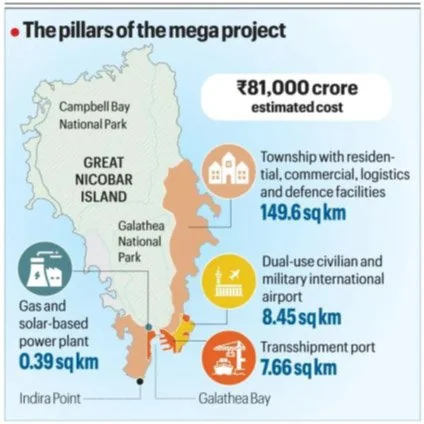
Total Cost
- ₹81,000 Crore
- The airport is one component of a larger mega-project.
MAJOR COMPONENTS
1. International Container Transshipment Terminal Location: Galathea Bay.
Objective
Reduce dependence on foreign transshipment hubs such as:
Benefits
- Boost maritime trade.
- Improve logistics efficiency.
- Increase India's role in global shipping.
2. Greenfield Airport
- Civil-military airport.
- Strategic aviation hub.
3. Power Infrastructure
- Reliable electricity supply.
- Support industrial and urban growth.
4. Township Development
Includes:
- Residential infrastructure.
-
- Commercial facilities.
- Social infrastructure.
GOVERNMENT’S JUSTIFICATION
Strategic Importance
Government argues that the project will:
- Enhance national security.
- Strengthen maritime surveillance.
- Improve military preparedness.
Economic Benefits
- Transform Great Nicobar into a maritime hub.
- Increase trade and investment.
- Create employment opportunities.
Connectivity Benefits
- Better connectivity with mainland India.
- Improved movement of people and goods.
ENVIRONMENTAL CONCERNS
Deforestation
Critics argue the project may require:
- Felling of over 1.5 crore trees.
Biodiversity Loss
Potential impact on:
- Tropical rainforests.
- Endemic species.
- Wildlife habitats.
Coral Reef Damage
Concerns regarding:
- Destruction of coral ecosystems.
- Marine biodiversity loss.
TRIBAL CONCERNS
Impact on Indigenous Communities Shompen Tribe
Most vulnerable community likely to be affected.
Concerns
- Habitat loss.
- Cultural disruption.
- Reduced access to traditional resources.
Importance of Shompen Tribe
- Classified as a Particularly Vulnerable Tribal Group (PVTG).
- Indigenous inhabitants of Great Nicobar.
- Depend heavily on forests for livelihood.
CRITICISM BY OPPOSITION
Rahul Gandhi's Concerns
Rahul Gandhi
Criticised the project on grounds of:
- Environmental destruction.
- Tribal displacement.
- Lack of transparency.
Major Questions Raised
Environmental Clearances
- Adequacy of impact assessments.
Financial Viability
- Cost-benefit justification.
Tribal Rights
- Protection of indigenous communities.
Alternative Options
- Why not expand INS Baaz instead?
KEY ADVANTAGES OF THE NEW AIRPORT
Greater Expansion Potential
- More land availability.
- Long-term infrastructure growth.
Better Military Utility
- Larger aircraft operations.
- Enhanced logistics capabilities.
Improved Civilian Connectivity
- Supports tourism and economic development.
Strategic Surveillance
- Better monitoring of maritime routes.
CHALLENGES AHEAD
Environmental Sustainability
- Balancing development with conservation.
Protection of Tribal Rights
- Ensuring participation and welfare of indigenous communities.
Project Implementation
- Cost management.
- Timely execution.
- Infrastructure development.
Strategic-Ecological Balance
- Meeting security needs without irreversible ecological damage.
CONCLUSION
The
Great Nicobar Island Development Project is one of India's most ambitious strategic infrastructure initiatives. The proposed
₹13,000 crore Greenfield Airport, along with the transshipment port and township development, can significantly strengthen India's
Indo-Pacific strategy, maritime security, trade connectivity and military reach. However, concerns relating to
forest loss, biodiversity, coral reefs and tribal communities such as the Shompen highlight the need for a balanced approach that combines
national security, economic development and environmental sustainability.
- Prelims: Key facts, institutions, locations and terminology in the article.
- Mains: Connect the topic with Environment, Economy, International Relations.
- Revision: Use the article headings to prepare concise notes and answer-writing points.
Test your understanding
Questions from this article
Prelims practiceWith reference to GREAT NICOBAR ISLAND DEVELOPMENT PROJECT, consider the following statements:
- The Government of India has approved a ₹13,000 crore Greenfield Civil-Military Airport in Great Nicobar Island.
- The airport will be developed near Galathea Bay under the larger ₹81,000 crore Great Nicobar Island Development Project.
- The government has decided not to expand INS Baaz, the existing naval air station at Campbell Bay.
Which of the statements given above are correct?
- 1 and 2 only
- 2 and 3 only
- 1 and 3 only
- 1, 2 and 3
View answer
Answer: (d) 1, 2 and 3. All three statements are drawn from the article.
Mains practiceDiscuss the background, key issues and significance of GREAT NICOBAR ISLAND DEVELOPMENT PROJECT for India.
Answer in 250 words.
View answer approach
- Why in News?
- KEY DECISION: NEW GREENFIELD CIVIL MILITARY AIRPORT
- WHY WAS INS BAAZ EXPANSION DROPPED?
- REASONS FOR REJECTION
- WHY GREAT NICOBAR MATTERS?
Frequently asked questionsFrequently asked questions
Why is Great Nicobar Island Development Project in the news?
The Government of India has approved a ₹13,000 crore Greenfield Civil-Military Airport in Great Nicobar Island. The airport will be developed near Galathea Bay under the larger ₹81,000 crore Great Nicobar Island Development Project.
What are the key facts about Great Nicobar Island Development Project?
The government has decided not to expand INS Baaz, the existing naval air station at Campbell Bay. The project has triggered debate over its strategic benefits, environmental impact, and tribal rights concerns. KEY DECISION: NEW GREENFIELD CIVIL MILITARY AIRPORT Location Chingen, near Galathea Bay.
Why is Great Nicobar Island Development Project important for UPSC preparation?
The topic connects current developments with Environment, Economy, International Relations and is relevant for both objective revision and analytical answer writing.