UPSC Current Affairs
GOBARDHAN: NATIONAL CIRCULAR BIOENERGY SCHEME
The Union Cabinet, chaired by Prime Minister Narendra Modi, has approved GOBARdhan – the National Circular Bioenergy Scheme. The scheme has a total outlay of ₹23,731 crore. It will be implemented from FY 2026–27 to FY 2035–36.
VRAuthor Desk
5 min read
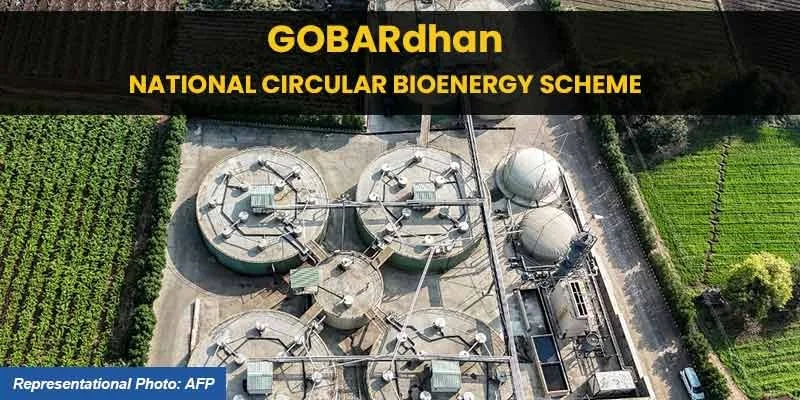
The Union Cabinet, chaired by Prime Minister Narendra Modi, has approved GOBARdhan – the National Circular Bioenergy Scheme. The scheme has a total outlay of ₹23,731 crore. It will be implemented from FY 2026–27 to FY 2035–36.
Why in News?
- The Union Cabinet, chaired by Prime Minister Narendra Modi, has approved GOBARdhan – the National Circular Bioenergy Scheme.
- The scheme has a total outlay of ₹23,731 crore.
- It will be implemented from FY 2026–27 to FY 2035–36.
- The scheme aims to make Compressed Biogas (CBG) a major part of India's future energy mix.
- It seeks to convert agricultural residue, cattle dung, press mud, municipal organic waste and other biomass into:
- Clean fuel
- Organic manure
- Rural income
- Economic value
KEY OBJECTIVES
- Increase domestic CBG production nearly ten-fold.
- Provide a predictable framework for the CBG industry.
- Mobilise large-scale private investment.
- Strengthen India's energy security.
- Create rural employment and income opportunities.
- Promote waste-to-wealth and a circular bioeconomy.
- Support the vision of Atmanirbhar Bharat and Viksit Bharat.
WHAT IS COMPRESSED BIOGAS?
- CBG is produced by processing organic waste and biomass.
- It is chemically equivalent to natural gas and can be integrated into India's existing gas ecosystem.
- It can be produced from resources such as:
- Agricultural residue
- Cattle dung
- Press mud
- Municipal organic waste
- Other biomass
- CBG can help reduce dependence on imported fossil fuels while creating value from organic waste.
FROM EXISTING SCHEMES TO GOBARDHAN
- The government has already developed the foundation of India's CBG sector through several initiatives:
- SATAT (Sustainable Alternative Towards Affordable Transportation) initiative
- Market Development Assistance (MDA) Scheme for organic manure
- Biomass Aggregation Machinery (BAM) Scheme
- Development of Pipeline Infrastructure (DPI) Scheme
- Central Financial Assistance (CFA) for CBG plants under the National Bioenergy Programme
- These initiatives have helped commission more than 200 CBG plants and establish production, offtake and organic manure value chains.
- GOBARdhan now brings these efforts together under one integrated national framework administered by the Ministry of Petroleum and Natural Gas.
SIX GROWTH ENGINES UNDER GOBARDHAN
1. Assured CBG Offtake
- The scheme creates a dedicated CBG Offtake Assurance framework.
- It will provide producers with a reliable and predictable market.
- City Gas Distribution (CGD) entities will support the notified CBG Obligation.
CBG Obligation trajectory:
- 3% in FY 2026–27
- 4% in FY 2027–28
- 5% from FY 2028–29 onwards
The obligation applies to the
CNG (Transport) and
PNG (Domestic) segments.
Significance:
- Creates long-term demand.
- Improves project bankability.
- Supports capacity utilisation.
- Encourages private investment.
2. Stable CBG Pricing Framework
- GOBARdhan introduces an administered CBG price of ₹2,110 per MMBTU.
- It will be supported through a government-backed pricing framework.
- The framework has a minimum 10-year horizon.
Significance:
- Provides revenue visibility.
- Improves investment certainty.
- Supports commercially attractive returns.
- Encourages capacity expansion.
3. Capital Assistance
- Eligible greenfield CBG projects can receive capital assistance of up to ₹2 crore per TPD of installed CBG capacity.
- Support can cover:
- Core plant machinery
- Feedstock aggregation
- Organic manure processing
- Value addition
- Brownfield projects expanding their production capacity will also be eligible.
Expected benefit:
- Lower initial capital burden.
- Easier financial closure.
- Greater participation by private developers, MSMEs, cooperatives and rural entrepreneurs.
4. Development of Pipeline Infrastructure
- The scheme supports:
- Cluster-based pipeline infrastructure
- Standalone pipeline infrastructure
- These pipelines will connect CBG plants with trunk pipelines and CGD networks.
Benefits:
- Lower evacuation costs.
- Better reliability.
- Wider market access.
- Higher utilisation of domestic CBG.
5. Credit Guarantee Support
- A dedicated Credit Guarantee mechanism will improve access to institutional finance.
- It will strengthen lender confidence in eligible MSME-based CBG projects.
- By sharing part of the lending risk, it can:
- Reduce collateral requirements.
- Improve access to affordable finance.
- Speed up project development.
It will particularly support
MSMEs, women entrepreneurs and first-time developers.
6. CBG Ecosystem Challenge Fund
- A dedicated CBG Ecosystem Challenge Fund will support district-level implementation.
- It will strengthen local CBG value chains through:
- Feedstock resource assessment and mapping
- Feedstock aggregation infrastructure
- District-level CBG development plans
- Technology adoption
- Process improvement
- Organic manure value addition
- Capacity building
- Stakeholder awareness
STRATEGIC IMPORTANCE FOR INDIA
Energy Security
- India's demand for natural gas is rising in:
- Transport
- Households
- Industry
- Commercial sectors
- Domestic CBG production can reduce dependence on imported fossil fuels.
- It can strengthen India's energy resilience.
Rural Economy
CBG plants can create local economic activity through:
- Biomass collection
- Feedstock transportation
- Plant operations
- Organic manure production
- Waste management
This can provide additional income opportunities for
farmers, cooperatives, feedstock aggregators and rural entrepreneurs.
Circular Economy
- GOBARdhan converts waste into useful economic resources.
- Organic waste ? CBG + Organic Manure + Rural Income
- This promotes a circular bioeconomy while reducing waste accumulation.
Environmental Benefits
The scheme can:
- Reduce greenhouse gas emissions.
- Promote productive utilisation of agricultural and organic waste.
- Reduce dependence on fossil fuels.
- Expand the production and use of organic manure.
EXPECTED IMPACT
GOBARdhan is expected to deliver:
- Nearly ten-fold growth in domestic CBG production.
- Greater energy security.
- Increased private investment.
- Stronger rural livelihoods.
- Better scientific waste management.
- Lower greenhouse gas emissions.
- Expansion of the organic manure economy.
- Faster project implementation through an integrated national framework.
SIGNIFICANCE OF GOBARDHAN
- The scheme brings together assured demand, stable pricing, capital assistance, pipeline connectivity, credit support and ecosystem development under one framework.
- It aims to transform India's large organic resource base into:
- Waste ? Clean Energy ? Organic Manure ? Rural Income ? Economic Growth
- Thus, GOBARdhan can become an important pillar of India's clean energy transition, circular economy, rural development and energy security, while supporting the broader goals of Atmanirbhar Bharat and Viksit Bharat.
- Prelims: Key facts, institutions, locations and terminology in the article.
- Mains: Connect the topic with Economy, Polity & Governance, Science & Technology.
- Revision: Use the article headings to prepare concise notes and answer-writing points.
Test your understanding
Questions from this article
Prelims practiceWith reference to GOBARDHAN: NATIONAL CIRCULAR BIOENERGY SCHEME, consider the following statements:
- The Union Cabinet, chaired by Prime Minister Narendra Modi, has approved GOBARdhan – the National Circular Bioenergy Scheme.
- The scheme has a total outlay of ₹23,731 crore.
- It will be implemented from FY 2026–27 to FY 2035–36.
Which of the statements given above are correct?
- 1 and 2 only
- 2 and 3 only
- 1 and 3 only
- 1, 2 and 3
View answer
Answer: (d) 1, 2 and 3. All three statements are drawn from the article.
Mains practiceDiscuss the background, key issues and significance of GOBARDHAN: NATIONAL CIRCULAR BIOENERGY SCHEME for India.
Answer in 250 words.
View answer approach
- Why in News?
- KEY OBJECTIVES
- WHAT IS COMPRESSED BIOGAS?
- FROM EXISTING SCHEMES TO GOBARDHAN
- SIX GROWTH ENGINES UNDER GOBARDHAN
Frequently asked questionsFrequently asked questions
Why is Gobardhan: National Circular Bioenergy Scheme in the news?
The Union Cabinet, chaired by Prime Minister Narendra Modi, has approved GOBARdhan – the National Circular Bioenergy Scheme. The scheme has a total outlay of ₹23,731 crore.
What are the key facts about Gobardhan: National Circular Bioenergy Scheme?
It will be implemented from FY 2026–27 to FY 2035–36. The scheme aims to make Compressed Biogas (CBG) a major part of India's future energy mix. It seeks to convert agricultural residue, cattle dung, press mud, municipal organic waste and other biomass into: Clean fuel Organic manure Rural income Economic value KEY OBJECTIVES Increase domestic CBG production nearly ten-fold.
Why is Gobardhan: National Circular Bioenergy Scheme important for UPSC preparation?
The topic connects current developments with Economy, Polity & Governance, Science & Technology and is relevant for both objective revision and analytical answer writing.