UPSC Current Affairs
ATLANTIC OCEAN CURRENT WEAKENING
Why in News Recent studies show that the Atlantic Meridional Overturning Circulation (AMOC) is steadily weakening Scientists warn that a possible collapse could: Increase global warming Disrupt climate systems worldwide Research published in scientific… AMOC (Atlantic Meridional Overturning Circulation) is a system of: Ocean currents acting like a conveyor belt How it Works Warm surface water moves: From tropics ? North Atlantic (Arctic region) Cold dense water sinks and returns: From North Atlantic ?
VRAuthor Desk
3 min read
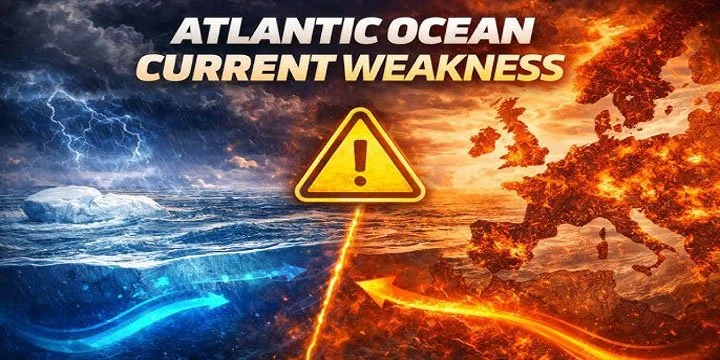
Why in News Recent studies show that the Atlantic Meridional Overturning Circulation (AMOC) is steadily weakening Scientists warn that a possible collapse could: Increase global warming Disrupt climate systems worldwide Research published in scientific… AMOC (Atlantic Meridional Overturning Circulation) is a system of: Ocean currents acting like a conveyor belt How it Works Warm surface water moves: From tropics ? North Atlantic (Arctic region) Cold dense water sinks and returns: From North Atlantic ?
Why in News
- Recent studies show that the Atlantic Meridional Overturning Circulation (AMOC) is steadily weakening
- Scientists warn that a possible collapse could:
- Increase global warming
- Disrupt climate systems worldwide
- Research published in scientific journals highlights:
- Risk of tipping point behaviour
This is a major concern for
global climate stability
WHAT IS AMOC?
- AMOC (Atlantic Meridional Overturning Circulation) is a system of:
- Ocean currents acting like a conveyor belt
How it Works
- Warm surface water moves:
- From tropics ? North Atlantic (Arctic region)
- Cold dense water sinks and returns:
- From North Atlantic ? tropics (deep ocean currents)
This circulation helps in:
- Regulating global climate
- Maintaining temperature balance
IMPORTANCE OF AMOC
- Controls:
- Climate of Europe and North America
- Helps in:
- Heat distribution across Earth
- Acts as:
- A climate stabilising system
Tipping Element
- AMOC is one of the Earth’s climate tipping elements
Meaning:
- It can undergo sudden and irreversible change
EVIDENCE OF WEAKENING
- Observations over the last two decades show:
- Continuous decline in AMOC strength
- Data collected from:
- Multiple ocean monitoring systems (mooring arrays)
- Strongest decline observed at:
Indicates AMOC may be approaching a
tipping point
CAUSES OF AMOC WEAKENING
(A) Global Warming
- Increase in greenhouse gases raises temperature
(B) Melting of Greenland Ice Sheet
- Releases large amounts of freshwater into ocean
(C) Reduction in Salinity
- Freshwater reduces:
- Salt concentration (salinity)
- This affects:
- Water density
- Ocean circulation
Key Problem:
- Weakens the sinking process of cold water
RISK OF COLLAPSE
- Studies suggest collapse could occur between:
- Even without additional warming:
- Collapse is still possible
Recovery may not occur in a
warming world
IMPACT OF AMOC COLLAPSE
(A) Global Warming Increase
(B) Carbon Cycle Disruption
- Release of:
- Southern Ocean may change from:
- Carbon sink ? Carbon source
(C) Regional Temperature Changes Northern Hemisphere
Southern Hemisphere
(D) Climate Imbalance
- Uneven temperature distribution
- Disruption of:
- Weather patterns
- Ocean systems
SEA ICE ALBEDO FEEDBACK
- Ice reflects more sunlight than water
- More cooling leads to:
- More ice increases:
This creates a
feedback loop of further cooling
SCIENTIFIC MODELLING
- Scientists used:
- Simulation method:
- Added freshwater to North Atlantic
- Adjusted salinity globally
Key Findings
- AMOC can collapse:
- Even without major warming
- Recovery is:
- Difficult in current climate conditions
BROADER IMPLICATIONS
- Risk of:
- Impacts on:
- Agriculture
- Fisheries
- Ecosystems
- Could trigger:
- Chain reactions in climate system
CHALLENGES IN MONITORING
- Difficult to:
- Measure ocean circulation continuously
- Scientists use:
- Ocean Bottom Pressure (OBP) data
Need for:
- Better long-term monitoring systems
- Prelims: Key facts, institutions, locations and terminology in the article.
- Mains: Connect the topic with Environment, Economy, Polity & Governance.
- Revision: Use the article headings to prepare concise notes and answer-writing points.
Test your understanding
Questions from this article
Prelims practiceWith reference to ATLANTIC OCEAN CURRENT WEAKENING, consider the following statements:
- Recent studies show that the Atlantic Meridional Overturning Circulation (AMOC) is steadily weakening
- Scientists warn that a possible collapse could: Increase global warming Disrupt climate systems worldwide
- Disrupt climate systems worldwide
Which of the statements given above are correct?
- 1 and 2 only
- 2 and 3 only
- 1 and 3 only
- 1, 2 and 3
View answer
Answer: (d) 1, 2 and 3. All three statements are drawn from the article.
Mains practiceDiscuss the background, key issues and significance of ATLANTIC OCEAN CURRENT WEAKENING for India.
Answer in 250 words.
View answer approach
- WHAT IS AMOC?
- IMPORTANCE OF AMOC
- EVIDENCE OF WEAKENING
- CAUSES OF AMOC WEAKENING
- RISK OF COLLAPSE
Frequently asked questionsFrequently asked questions
Why is Atlantic Ocean Current Weakening in the news?
Why in News Recent studies show that the Atlantic Meridional Overturning Circulation (AMOC) is steadily weakening Scientists warn that a possible collapse could: Increase global warming Disrupt climate systems worldwide Research published in scientific… AMOC (Atlantic Meridional Overturning Circulation) is a system of: Ocean currents acting like a conveyor belt How it Works Warm surface water moves: From tropics ?
What are the key facts about Atlantic Ocean Current Weakening?
North Atlantic (Arctic region) Cold dense water sinks and returns: From North Atlantic ? tropics (deep ocean currents) This circulation helps in: Regulating global climate Maintaining temperature balance IMPORTANCE OF AMOC Controls: Climate of Europe and North America Helps in: Heat distribution across Earth Acts as: A climate stabilising system… Carbon source (C) Regional Temperature Changes Northern Hemisphere Arctic cooling: Up to 7°C decrease Cause: Reduced heat transport Southern Hemisphere Antarctica warming: Up to 6–10°C increase (D) Climate Imbalance Uneven temperature distribution Disruption…
Why is Atlantic Ocean Current Weakening important for UPSC preparation?
The topic connects current developments with Environment, Economy, Polity & Governance and is relevant for both objective revision and analytical answer writing.