UPSC Current Affairs
AI & INDIA’S AADHAR UPI MODEL
Context India has successfully built digital public infrastructure (DPI) such as Aadhaar and UPI, enabling secure identity and payments for over a billion people. With AI reshaping global economies, India now aims to build an AI ecosystem rooted in Indian laws, green computing, and citizen-centric digital systems. This moment is seen as a potential leapfrog opportunity similar to how India jumped from no landline network to mass mobile connectivity.
VRAuthor Desk
3 min read

Context India has successfully built digital public infrastructure (DPI) such as Aadhaar and UPI, enabling secure identity and payments for over a billion people. With AI reshaping global economies, India now aims to build an AI ecosystem rooted in Indian laws, green computing, and citizen-centric digital systems. This moment is seen as a potential leapfrog opportunity similar to how India jumped from no landline network to mass mobile connectivity.
Context
India has successfully built digital public infrastructure (DPI) such as
Aadhaar and
UPI, enabling secure identity and payments for over a billion people. With AI reshaping global economies, India now aims to build an
AI ecosystem rooted in Indian laws, green computing, and citizen-centric digital systems. This moment is seen as a potential
leapfrog opportunity similar to how India jumped from no landline network to mass mobile connectivity.
WHAT IS INDIA’S AI OPPORTUNITY?
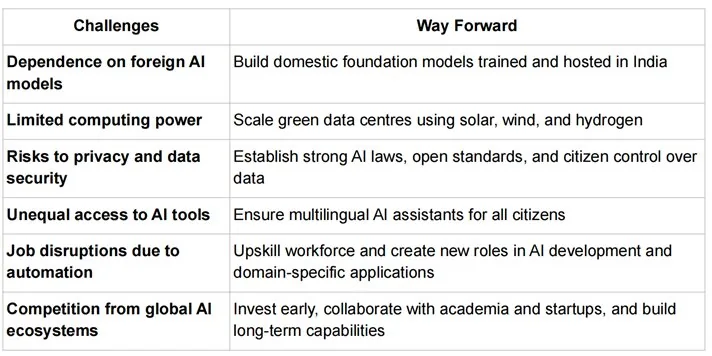
- AI will transform how people learn, work, access services, and make decisions. But it can also disrupt India’s strengths, especially IT and back-office work, where automation may reduce certain roles.
- India can convert this challenge into an opportunity because:
- It already has identity (Aadhaar) and payments (UPI) infrastructure at scale.
- It has large datasets, growing internet access, and a young, tech-savvy population.
- It aims to combine AI + renewable energy to build a sustainable, globally competitive AI ecosystem.
- India can build an AI system similar to its DPI model: inclusive, affordable, lawful, secure, and built for India’s needs.
WHY INDIA NEEDS ITS OWN AI FRAMEWORK?
Three concerns make domestic AI capability essential:
- Digital Sovereignty: If powerful AI systems operate from abroad, India loses control over:
- Data usage
- Algorithmic decisions
- Bias and accountability
- Security risks
- National Security: AI will increasingly run:
- Public infrastructure
- Administrative systems
- Defence, energy, and financial services
- Foreign-controlled AI creates vulnerabilities.
- Economic Competitiveness: India must avoid depending on foreign AI in the same way it depends on foreign hardware manufacturing. Building domestic AI ensures high-value jobs, nt just low-value back-office tasks.
HOW INDIA CAN BUILD ITS AI FUTURE?
- AI Must Operate Under Indian Law and Jurisdiction
- Foundation models (large AI systems) must be trained, hosted, and regulated in India.
- India must chart its own path - not the corporate-led American model or the State-controlled Chinese model.
- Domestic AI ensures:
- Data stays in India
- Accountability to Indian users
- Transparent and secure AI operations
- Just as Aadhaar and UPI were designed for Indian needs, India now needs its own AI intelligence layer.
- Build a Green, Low-Carbon AI Infrastructure
- AI requires massive computing power - currently concentrated mostly in the US and China.
- India must quickly expand its capacity by building green data centres powered by:
- Solar and wind energy
- Green hydrogen
- Energy-efficient cooling systems
- Next-generation semiconductors and power electronics
- This becomes a green industrial opportunity, stimulating investment in:
- Renewable energy
- Data-centre technology
- AI hardware ecosystems
- India can leap directly to a green frontier, where economic growth and sustainability go together.
- Every Indian Should Have a Multilingual Personal AI Agent
- India’s future AI ecosystem should give every citizen a secure, private, multilingual AI assistant that they control.
- Examples:
-
- A farmer receives weather, pest, and crop advice in his local language.
- A student uses AI for language learning and revision support.
- A patient manages medical records and receives health guidance.
- Key features:
- Secure data storage
- User control over information
- Privacy and transparency
- Open standards for interoperability
- This mirrors Aadhaar-UPI principles: inclusion, accessibility, trust, and scale.
IMPLICATIONS
- New economic opportunities in data infrastructure, model development, and AI-powered services.
- Potential job shifts in IT and back-office sectors due to automation.
- Enhanced national security through domestic AI governance.
- Green economic growth driven by renewable-energy-powered AI.
- Stronger global competitiveness, similar to how India built leadership in digital payments.
- Prelims: Key facts, institutions, locations and terminology in the article.
- Mains: Connect the topic with Economy, International Relations, Defence.
- Revision: Use the article headings to prepare concise notes and answer-writing points.
Test your understanding
Questions from this article
Prelims practiceWith reference to AI & INDIA’S AADHAR UPI MODEL, consider the following statements:
- AI will transform how people learn, work, access services, and make decisions. But it can also disrupt India’s strengths, especially IT and back-office work, where automation may reduce certain roles.
- India can convert this challenge into an opportunity because: It already has identity (Aadhaar) and payments (UPI) infrastructure at scale. It has large datasets, growing internet access, and a young, tech-savvy…
- It already has identity (Aadhaar) and payments (UPI) infrastructure at scale.
Which of the statements given above are correct?
- 1 and 2 only
- 2 and 3 only
- 1 and 3 only
- 1, 2 and 3
View answer
Answer: (d) 1, 2 and 3. All three statements are drawn from the article.
Mains practiceDiscuss the background, key issues and significance of AI & INDIA’S AADHAR UPI MODEL for India.
Answer in 250 words.
View answer approach
- WHAT IS INDIA’S AI OPPORTUNITY?
- HOW INDIA CAN BUILD ITS AI FUTURE?
- IMPLICATIONS
Frequently asked questionsFrequently asked questions
Why is Ai & India’S Aadhar Upi Model in the news?
Context India has successfully built digital public infrastructure (DPI) such as Aadhaar and UPI, enabling secure identity and payments for over a billion people. With AI reshaping global economies, India now aims to build an AI ecosystem rooted in Indian laws, green computing, and citizen-centric digital systems.
What are the key facts about Ai & India’S Aadhar Upi Model?
This moment is seen as a potential leapfrog opportunity similar to how India jumped from no landline network to mass mobile connectivity. AI will transform how people learn, work, access services, and make decisions. But it can also disrupt India’s strengths, especially IT and back-office work, where automation may reduce certain roles.
Why is Ai & India’S Aadhar Upi Model important for UPSC preparation?
The topic connects current developments with Economy, International Relations, Defence and is relevant for both objective revision and analytical answer writing.