UPSC Current Affairs
67,800 YEAR OLD STENCIL-OLDEST KNOWN ROCK ART FOUND IN INDONESIA
A hand stencil rock painting discovered in a limestone cave in Sulawesi, Indonesia, has been dated to at least 67,800 years old. It is now considered the oldest known rock art in the world. The discovery pushes back the timeline of human symbolic expression and artistic activity.
VRAuthor Desk
3 min read
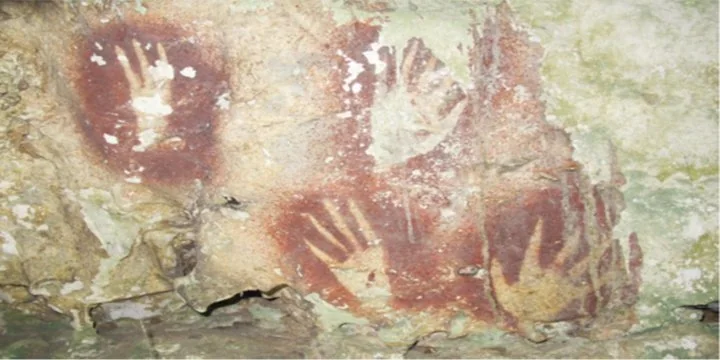
A hand stencil rock painting discovered in a limestone cave in Sulawesi, Indonesia, has been dated to at least 67,800 years old. It is now considered the oldest known rock art in the world. The discovery pushes back the timeline of human symbolic expression and artistic activity.
Why in News?
- A hand stencil rock painting discovered in a limestone cave in Sulawesi, Indonesia, has been dated to at least 67,800 years old.
- It is now considered the oldest known rock art in the world.
- The discovery pushes back the timeline of human symbolic expression and artistic activity.
WHERE WAS THE DISCOVERY MADE?
- The rock art was discovered in Liang Metanduno Cave on Muna Island, located near Sulawesi in Indonesia.
- Important facts:
- The cave lies in Southeastern Sulawesi
- This region is part of Wallacea, a group of islands between Asia and Australia
- The area had previously received limited archaeological research
WHAT WAS DISCOVERED?
- Researchers found a hand stencil painting created by spraying pigment around a human hand placed on the cave wall.
- This created a negative handprint, which is a common form of prehistoric rock art.
- However, this stencil shows a unique feature:
- The finger shapes were narrowed, giving it a claw-like appearance
- This may represent symbolic ideas linking humans and animals.
HOW WAS THE AGE DETERMINED?
- Scientists used Uranium-Series Dating to determine the age of the painting.
- Method used:
- Calcite mineral layers formed naturally on top of the painting
- These mineral deposits were analysed using laser ablation uranium-series techniques
- Results:
- Mineral layer age: 71,600 years
- Minimum age of the painting: 67,800 years
- This establishes the oldest confirmed cave art date so far.
EARLIER OLDEST ROCK ART
- Before this discovery, the oldest known rock art was:
- Cave art in Spain
- Believed to be created by Neanderthals
- The Sulawesi discovery is more than 16,000 years older than earlier examples from Indonesia’s Maros–Pangkep caves.
OTHER ROCK ART DISCOVERIES IN THE REGION
- Researchers documented 44 rock art sites in Southeastern Sulawesi.
- Key findings:
- 11 motifs dated from 8 sites
- 7 hand stencils
- Several figurative and geometric paintings
- Evidence shows artistic activity continued in the region until around 20,000 years ago.
LINK WITH EARLY HUMAN MIGRATION
- The discovery also helps explain early human migration patterns.
- During the Pleistocene period:
- Australia, New Guinea and Tasmania formed a single landmass called Sahul
- Early humans likely travelled through Wallacea islands to reach Sahul
- Some theories suggest humans reached the region around 50,000 years ago, while others propose 65,000 years ago.
- The 67,800-year-old rock art supports the idea that modern humans arrived earlier than previously believed.
IMPORTANCE OF THE DISCOVERY
The finding is significant for several reasons:
- Shows early humans created symbolic art much earlier
- Provides evidence of advanced cognitive abilities
- Supports theories of early seafaring migration across Southeast Asia
- Highlights Sulawesi as an important prehistoric cultural region
CONCLUSION
The discovery of a
67,800-year-old hand stencil in Sulawesi, Indonesia, is the
oldest known rock art in the world. It reveals that early humans had
symbolic thinking and artistic traditions far earlier than previously believed, and it also strengthens evidence about
early human migration routes toward Australia and the Pacific region.
- Prelims: Key facts, institutions, locations and terminology in the article.
- Mains: Connect the topic with Economy, Polity & Governance.
- Revision: Use the article headings to prepare concise notes and answer-writing points.
Test your understanding
Questions from this article
Prelims practiceWith reference to 67,800 YEAR OLD STENCIL-OLDEST KNOWN ROCK ART FOUND IN INDONESIA, consider the following statements:
- A hand stencil rock painting discovered in a limestone cave in Sulawesi, Indonesia, has been dated to at least 67,800 years old.
- It is now considered the oldest known rock art in the world.
- The discovery pushes back the timeline of human symbolic expression and artistic activity.
Which of the statements given above are correct?
- 1 and 2 only
- 2 and 3 only
- 1 and 3 only
- 1, 2 and 3
View answer
Answer: (d) 1, 2 and 3. All three statements are drawn from the article.
Mains practiceDiscuss the background, key issues and significance of 67,800 YEAR OLD STENCIL-OLDEST KNOWN ROCK ART FOUND IN INDONESIA for India.
Answer in 250 words.
View answer approach
- Why in News?
- WHERE WAS THE DISCOVERY MADE?
- WHAT WAS DISCOVERED?
- HOW WAS THE AGE DETERMINED?
- EARLIER OLDEST ROCK ART
Frequently asked questionsFrequently asked questions
Why is 67,800 Year Old Stencil-Oldest Known Rock Art Found In Indonesia in the news?
A hand stencil rock painting discovered in a limestone cave in Sulawesi, Indonesia, has been dated to at least 67,800 years old. It is now considered the oldest known rock art in the world.
What are the key facts about 67,800 Year Old Stencil-Oldest Known Rock Art Found In Indonesia?
The discovery pushes back the timeline of human symbolic expression and artistic activity. The rock art was discovered in Liang Metanduno Cave on Muna Island, located near Sulawesi in Indonesia. Important facts: The cave lies in Southeastern Sulawesi This region is part of Wallacea, a group of islands between Asia and Australia The area had previously received limited archaeological research WHAT WAS DISCOVERED?
Why is 67,800 Year Old Stencil-Oldest Known Rock Art Found In Indonesia important for UPSC preparation?
The topic connects current developments with Economy, Polity & Governance and is relevant for both objective revision and analytical answer writing.